
6.1Sustainability at Royal Avebe
In this ESG chapter, we report on our objectives, actions, and results in the areas of environment, society, and governance - commonly referred to by the English terms Environmental, Social, and Governance (ESG). Royal Avebe intends to voluntarily report in accordance with the European Corporate Sustainability Reporting Directive (CSRD) starting from the 2027/2028 financial year. This directive promotes transparency and comparability of sustainability performance across organisations.
Reporting basis and scope
This ESG chapter is part of Avebe’s integrated annual report for the 2024/2025 financial year (1 August 2024 to 31 July 2025). The report covers the activities of Coöperatie Royal Avebe U.A. and its subsidiaries, including relevant parts of the value chain where material sustainability topics have been identified. A further step has been taken to align the sustainability information with the upcoming CSRD requirements and the associated European Sustainability Reporting Standards (ESRS). Where applicable, elements of the Global Reporting Initiative (GRI) standards have also been integrated. The reporting boundaries are aligned with Avebe’s financial consolidation scope. For material topics with impact beyond the organisation, information is also included about upstream and downstream activities in the value chain. This scope is based on the outcomes of the double materiality analysis conducted.
Sustainability as the foundation of our strategy
Sustainability is the foundation of our Accelerate and Strengthen strategy. As a cooperative with a strong agricultural base and a leading position in plant-based ingredients, we see it as both our responsibility and opportunity to contribute to a sustainable future. Our plant-based products help customers in the food, construction, and packaging industries reduce their ecological footprint. Many of our solutions are not only bio-based but also circular in nature. We focus on structurally reducing our own environmental impact, including lowering energy consumption, limiting water extraction, and circular use of residual flows. At the same time, we support our customers in achieving their sustainability goals. On the cultivation side, we invest through our subsidiary Averis Seeds B.V. in developing robust potato varieties that are more resistant to drought and diseases, and that yield higher returns with fewer crop protection agents.
Seven sustainability programs have been established within our strategy, covering the entire value chain. Each program has clear objectives and is led by a program manager. These managers report multiple times a year to the executive committee. Progress on the sustainability strategy is periodically discussed with the board and the supervisory board, which oversee its implementation. With this integrated approach, we are building a future-proof cooperative that creates value for members, customers, employees, and society as a whole.
Silver EcoVadis score
In 2025, Avebe achieved a Silver EcoVadis score. This recognition places us among the top 15 per cent of assessed companies in our sector. EcoVadis evaluates sustainability performance internationally in areas such as environment, human and labour rights, ethics, and procurement. Through collaboration with suppliers and customers, Avebe strengthens sustainability performance across the entire chain. The Silver EcoVadis score confirms these efforts and highlights the importance of continuous sustainability improvement throughout the organisation.
6.2ESG Governance
ESG is fully integrated into Avebe’s governance structure. For further details, we refer to the Corporate Governance chapter of this annual report, which explains the key elements of our governance framework.
Projectgroep ESG-CSRD
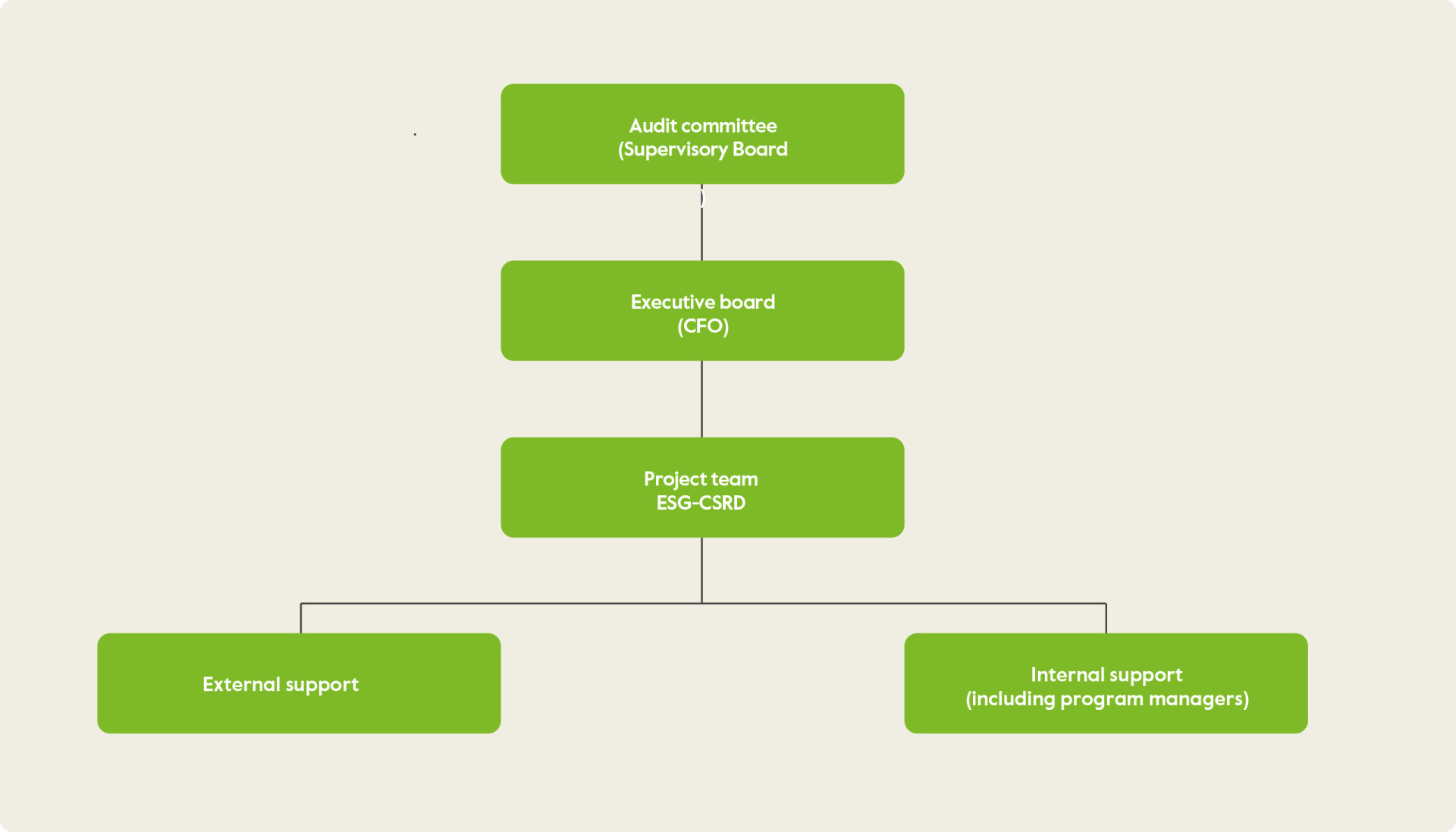
In the 2022/2023 financial year, we launched the ESG-CSRD project with a dedicated project group.
The team consists of employees from the Finance, Internal Audit, and Sustainability departments, under the responsibility of the Chief Financial Officer (CFO). A broad group of internal experts is involved in the process, and external support is also utilised. Below is the organisational chart of the project structure:
The first major step was conducting a Double Materiality Analysis (DMA) to identify the material ESG topics for Avebe, see 6.3 Double materiality analysis for further information.
Securing sustainability expertise
The board, executive committee, and supervisory board attend multiple annual meetings focused on sustainability topics, both internal and external. Program managers report on material impacts, risks, and opportunities within their strategic programs. Topics discussed include sustainable agriculture, energy management, biodiversity, waste, transport, and (future) legislation.
Sustainability strategy is embedded in Avebe’s planning and control cycle. Monthly reports are submitted to the board, executive committee, and supervisory board on key performance indicators related to sustainability. Knowledge from strategic sustainability programs is periodically shared by experts in water, energy, circularity, sustainable procurement, and sustainable agriculture.
Specialised sustainability knowledge, developments, and applicable legislation are managed by the ESG-CSRD project team and the sustainability office under Operations. They report periodically to the board and supervisory board on CSRD implementation progress, ESG developments, and performance monitoring.
Due diligence approach at Avebe
Avebe applies a due diligence approach anchored in our Responsible Sourcing Policy (RSP). Although a standardised due diligence process is not yet in place, the RSP provides a strong foundation. In line with CSRD, this approach will be strengthened and expanded in the coming years. It is based on international standards such as the UN Guiding Principles on Business and Human Rights and aligns with OECD Guidelines for Multinational Enterprises, ensuring compliance with global expectations for responsible business conduct. The table below outlines how Avebe addresses the five core elements of due diligence:
| Key Elements of Due Diligence | Avebe’s Approach and References |
|---|---|
| Embedding due diligence in governance, strategy, and the business model | Avebe does not yet have a standardized due diligence process. The current approach is embedded in our RSP and integrated into our governance structure. |
| Involving stakeholders in all major steps of the due diligence process | Our approach to engaging with stakeholders is explained in step 2 of the DMA process and Appendix 3. |
| Identifying and assessing (potential) adverse impacts | We identify risks related to human rights, the environment, and ethics in our supply chains through our DMA process. |
| Taking action and describing processes to address these adverse impacts | We set clear requirements for suppliers, who are obliged to comply with the principles of our RSP, and we monitor compliance through supplier assessments and contractual agreements. Further actions are described under the material topics. |
| Monitoring and communicating the effectiveness of these efforts | We offer remediation mechanisms, such as our SpeakUp and whistleblower policy, for reporting misconduct. Additionally, we periodically evaluate and update our approach based on new legislation, stakeholder dialogue, and developments in the supply chain. |
ESG risks and internal control
Risk management is an integral part of Avebe’s operations. ESG-related risks are not yet explicitly included in the formal risk management process or in the risk section of this report. However, they are systematically identified and monitored through our strategic sustainability programs. These programs report on material impacts, risks, and opportunities, which are discussed at the executive level. Topics include climate change, water availability, resource security, and evolving legislation.
ESG risks are also indirectly considered in decisions on investments, compliance, permits, and strategic planning. We are exploring how to structurally integrate ESG risks into our broader risk management framework, in line with CSRD requirements.

6.3Double materiality analysis
We periodically conduct a materiality analysis to identify which topics stakeholders consider most impactful for Avebe. This analysis helps prioritise sustainability topics both strategically and operationally and forms the basis for future CSRD reporting. Based on the Global Reporting Initiative (GRI) standards, only external impact, i.e. Avebe's influence on its environment, is taken into account when determining material topics. In order to prepare ourselves properly for the requirements of the CSRD, we conducted a double materiality analysis in the 2023/2024 financial year.
Double materiality
A double materiality analysis determines which sustainability topics are most important for an organisation. As the name suggests, this analysis is conducted from two perspectives. On the one hand, there is an outward impact analysis, which assesses Avebe’s influence on its surroundings (people and the environment) in relation to a specific topic, such as CO₂ emissions. This impact may be caused directly by Avebe’s own operations, but Avebe may also be connected to the impact. In that case, the impact occurs within the organisation’s value chain. On the other hand, there is an inward impact analysis. This examines the financial consequences for Avebe related to a topic, such as costs, risks or reputation. In this way, a sustainability topic is assessed from two perspectives. The higher the score, the more important the topic is for our cooperative.
Process
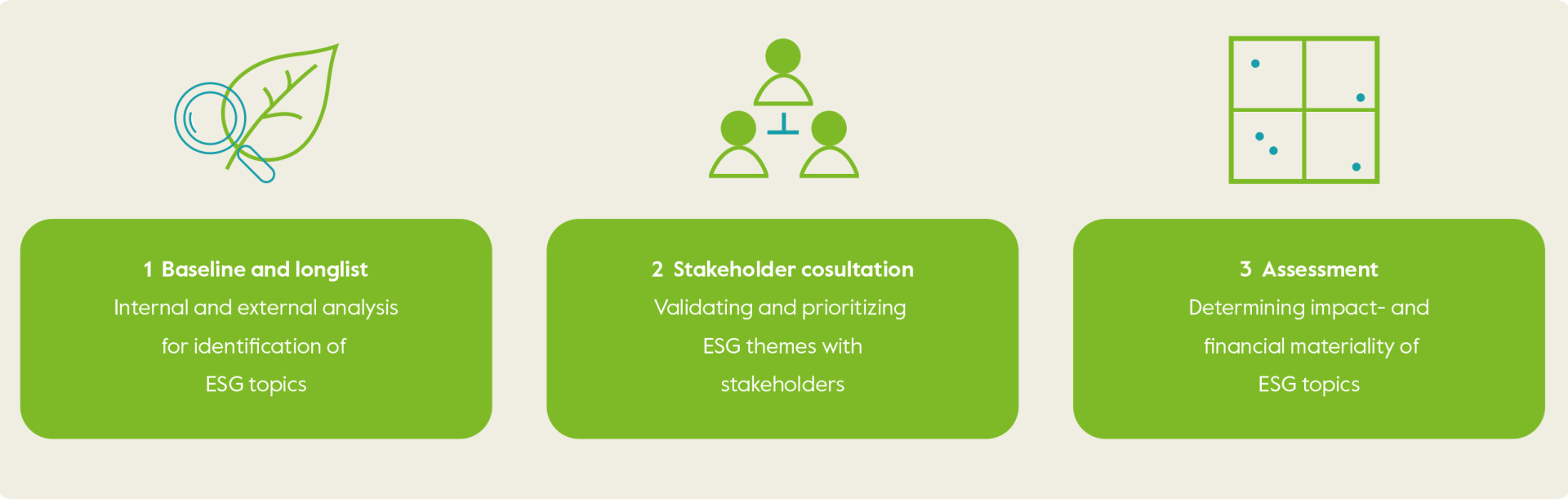
The steps Avebe took to identify the material topics are shown below:
Step 1: Understanding context and topic List
For our materiality analysis, we mapped out Avebe's environment. This involved gaining insight into our value chain, our value creation model and identifying stakeholders. Our most important stakeholders are: our members, employees, customers, suppliers, credit institutions and regulatory authorities. Other stakeholders with whom we actively engage in dialogue and cooperation include knowledge institutions, social organisations, NGOs, residents living near our production sites and industry organisations such as VNCI and BO Akkerbouw. We also take into account other stakeholders whose interests may be affected by the activities of Avebe and its direct and indirect business relationships within its value chain.
We then drew up a list of potential material topics (long list). We evaluated and adjusted the long list through an internal analysis based on the new Strengthen and Accelerate 2023-2028 strategy and discussions with the program managers of the sustainability programs. We conducted the external analysis on the basis of a desktop review. We consulted known and available sources, including (draft) standards and guidelines. We also assessed publicly available information from suppliers and fellow companies, taking into account the size of the companies, the type of companies and their maturity in terms of sustainability. The outcome of these analyses resulted in a list of potential material topics for Avebe.
Step 2: Stakeholder dialogue and prioritisation
In two extensive workshops, one focused on environmental issues and the other on social and governance-related topics, we assessed the potential internal and external impact of the material issues together with internal experts and external advisors. When identifying the impact, we took into account both Avebe's own impact and the indirect impact resulting from our chain. We also assessed and discussed the severity of the effects, taking into account their scope, scale and irreversibility. Financial risks and opportunities were assessed based on the likelihood of their occurrence and their potential financial impact on Avebe. We determined the potential financial impact by looking at the size of possible financial gains or losses. We measure this by mapping the change in resources available to Avebe (natural, social and economic). We then prioritised the topics for both impact materiality and financial materiality. In our discussions, we took into account the current and potential consequences for the coming year, but also for the next five years and beyond. The scores and prioritisation resulting from this were recorded by the project team. Based on this, a shorter list of material topics was drawn up in draft form (shortlist).
Step 3: Validation of outcomes
The results of the workshops were then presented and discussed in the Social Advisory Council (MAR). The MAR consists of representatives from key stakeholder groups. Through the MAR, we gather insights from interested stakeholders in order to gain new insights or test ideas. This session was attended by a diverse group of external stakeholders (government, NGOs, academia, business, farmers), as well as internal stakeholders, such as members of the board of directors and the supervisory board. The final scoring and outcomes were determined on the basis of input from the project team, the workshop sessions, the discussions with the MAR and other activities. The outcomes were then submitted for validation to the executive committee, the audit committee and the supervisory board, and thus made final.
Update of material topics
No new double materiality analysis was carried out in the 2024/2025 reporting year. However, based on substantive coherence and strategic alignment, it was decided to combine the topics of water extraction and water pollution into a single integrated theme: water extraction. This decision was made because both topics are closely related. In order to further reduce water extraction, it is also necessary to reduce the use of additives, such as chemicals. This integration creates a more holistic approach to water management within Avebe, which is more in line with our strategic sustainability goals and operational reality.
Overview of material topics
Below is an overview of the outcomes from the double materiality analysis. We will then provide further details on the various topics. Together with our stakeholders, we continue to monitor and validate the material topics. The double materiality analysis is periodically reviewed to respond to changing circumstances, stakeholder expectations and legislation. The elaboration of the material topics and the associated action plans are also monitored and adjusted where necessary.

6.4Material Topics
| Theme &Value Chain | Impact | Risk/Opportunity |
|---|---|---|
| Climate change mitigation Own operations, upstream and downstream value chain |
The production of (modified) starch and protein requires energy and therefore results in CO₂ emissions. In addition, CO₂ is emitted in the value chain, for example through the cultivation of starch potatoes. These impacts contribute to climate change. | Climate-related regulations and stricter emission standards in production and agriculture may lead to higher costs, including the mandatory purchase of CO₂ rights. |
| Energy management Own operations |
Due to our high energy consumption and the resulting CO₂ emissions, we have a negative impact on the environment and climate change. | Changes in climate-related laws and regulations may result in higher energy costs and obstacles in obtaining permits for future investments. Additionally, grid congestion poses a risk to the long-term availability of electricity. |
| Raw material security Upstream value chain, own operations |
The cultivation of starch potatoes impacts the climate, water, and soil, among other things. | Our members face stricter laws and regulations, climate change, high cultivation costs, and competition with other crops. These factors pose risks to the short- and long-term availability of raw materials, with the danger that members’ earning capacity may come under pressure. |
| Water withdrawals Own operations |
We withdraw large amounts of (surface) water for our production processes, which is discharged back into surface water as treated effluent after use. | Due to changing weather conditions and prolonged drought, there is a risk that we may not be able to extract sufficient water for our production. |
| Circular residual flows Own operations |
Theme not material in terms of impact | Sludge is a residual stream with negative economic value for Avebe. Tarra is a waste stream for which finding a valuable application is difficult. By potentially using these residual streams in a circular way and reducing processing costs, a financial opportunity arises for Avebe. |
| Plant-based products for industrial market Own operations |
Theme not material in terms of impact | Innovating and growing in sustainable ingredients for industrial applications offers a financial opportunity for Avebe. |
| Safe working Own operations |
Accidents that occur have a negative impact on the safety and health of employees | A lack of safe working practices can lead to production stoppages, sanctions, legal liability, and reputational damage. This can harm trust in Avebe and its products, negatively impacting our revenue. |
| Attractive employer Own operations |
As an employer, we have a significant influence on our employees. Our impact is focused on providing an inclusive working environment and facilitating employee development. | Insufficient attention to employees may lead to a loss of attractiveness in the labor market and an inefficient organization, which poses a financial risk for Avebe. |
| Food safety Downstream value chain |
Food safety issues can have negative consequences for our customers and the environment. When quality standards are not met, there may be health risks for consumers. | Theme not financially material |
| Plant-based nutrition Own operations and downstream value chain |
We are proud of the role we play in promoting healthier, more sustainable, and plant-based nutrition and the positive impact we have on consumers. | With potato starch and protein, we can offer unique properties and help our customers achieve their goals by offering sustainable and plant-based products to consumers. This provides a financial opportunity for Avebe to further expand its position and markets. |
| Business ethics Own value chain, upstream and downstream value chain |
Avebe stands for fair and transparent business operations. This means we handle the interests and rights of employees, suppliers, member farmers, customers, and our environment with care. | A related risk is that Avebe may not be seen as a company that advocates fair and transparent business practices. |
6.4.1 Climate change mitigation
Impact, risks and opportunities
Climate change, with a focus on CO₂ reduction, affects both our own operations and our value chain. The production of (modified) starch and protein requires energy and results in CO₂ emissions - both direct and indirect. Key risks include climate-related regulatory changes and legislation aimed at reducing emissions in production and agricultural activities. CO₂ emissions also incur substantial costs, such as purchasing emission rights. By saving energy and switching to sustainable energy sources (cost-effectively), we can reduce CO₂ emissions.
Strategy
Our Accelerate and Strengthen strategy outlines our sustainability goals for 2030, a key milestone toward climate neutrality by 2050. Avebe aims to align its CO₂ reduction targets with a maximum global warming of 1.5°C, in accordance with the Paris Agreement. For the period 2023–2030, we target a 30 per cent reduction in CO₂ emissions, using 2022/2023 as the baseline. This target applies to scope 1 emissions: direct greenhouse gas emissions from our operations. Scope 2 emissions (indirect emissions from purchased electricity and heat) are already zero, and we aim to maintain this through 2030. Our scope 1 and 2 emissions (market-based scope 2) are composed as follows: 99 per cent of the emissions result from the combustion of natural gas. Of this, 57 per cent is related to electricity generation in the combined heat and power plants, 36 per cent to steam production for manufacturing processes, and 6 per cent to directly fired dryers and central heating systems.
For our Scope 3 emissions (indirect CO₂ emissions caused by third-party business activities), we also have the ambition to reduce them by 30 per cent compared to the reference year. By making this distinction in scope, we align with the way governments formulate targets for the reduction of greenhouse gases. Scope 3 emissions include indirect emissions from, among other things, the procurement of raw materials, transport and packaging materials. These categories represent a significant part of our total CO₂ footprint. In our strategy, we have included the CO₂ and energy reduction program "Towards climate neutral", and Scope 3 is incorporated into the "Sustainable procurement" program.
Approach and action plans
From the strategic program, a concrete plan has been drawn up to meet the reduction targets for Scope 1 (and 2) emissions. This plan is divided into two parts: a 30 per cent reduction by 2030, supported by an action plan with specific required measures and investments.
Electrification and process optimisation
One example is the planned investment in an electric steam boiler at our production site in Foxhol in 2025, which will result in CO₂ savings in the 2025/2026 financial year. In addition, we are seeking further improvements in our processes and activities aimed at increasing the efficiency and effectiveness of our production. This will save us approximately 1.5 per cent energy (and also CO₂) per year. For the target of becoming climate neutral by 2040, we have mapped out the options available to Avebe for completely CO₂-neutral production. We are closely monitoring developments in this area. The first steps towards electrification have been taken through the implementation of membrane technology and electric steam boilers. There are plans for further electrification.
Grid capacity and renewable energy
Grid congestion poses a potential bottleneck for further electrification and the expansion of renewable energy generation. At present, two solar parks at Avebe sites are already connected via Avebe’s electricity grid. We are exploring the possibilities for further connection of local renewable electricity production.
Sustainability in the supply chain
For our Scope 3 emissions, we already have a clear view of the most important categories for us. Therefore, we have already initiated several projects, including initiatives in the areas of chemicals, transport and packaging materials. We also achieve savings by taking these factors into account in tendering processes with suppliers. In an increasing number of procurement processes, we apply minimum sustainability criteria and sustainability is systematically considered in our selection and contracting processes. In the coming year, we will continue with the ongoing projects and keep looking for structural improvements in our supply chain.
Goals and achievements
Targets for 2030 have been set as follows: a carbon dioxide (CO₂) reduction target of 30 per cent for scope 1 and scope 3, and zero scope 2 emissions.
In the financial year 2024/2025, scope 1 CO₂ emissions amounted to 160 kilotons, or 0.195 tonnes of CO₂ per tonne of product. Scope 2 CO₂ emissions were zero. This concerns the emitted CO₂ (scope 1 and 2), corrected for production carried out for third parties (other companies on site). The emission factor for Guarantees of Origin (GvOs) for green electricity has been set to zero. Total scope 1 CO₂ emissions are in line with the previous year and 19 per cent lower than the reference year 2022/2023. Scope 1 CO₂ emissions per tonne of product were 3.1 per cent lower than the previous year and 7.1 per cent lower than the reference year 2022/2023. A significant part of this reduction is attributable to the extended campaign in Ter Apelkanaal and the replacement of the amniotic fluid decanters in Gasselternijveen.
See the overview of scope 1 and scope 2 emissions below for further details.
| Overview of Scope 1 and Scope 2 Emissions | Unit | 2022/2023 (Ref) | 2023/2024 | 2024/2025 | Current savings (%) | Goal 2030 savings (%) |
|---|---|---|---|---|---|---|
| Scope 1 emissions | ||||||
| Gross Scope 1 emissions (Avebe) | tons | 197.329 | 160.397 | 159.675 | 19.1 | 30 |
| Gross Scope 1 emissions per ton of product | kg CO₂/Tonne | 210 | 201 | 195 | 7.1 | 30 |
| Gross Scope 1 emissions by third parties | tons | 8.580 | 10.011 | 11.181 | - | - |
| Scope 1 emissions under ETS | % | 87% | 85% | 85% | - | - |
| Scope 2 emissions | ||||||
| Location-based Scope 2 emissions | tons | 26.755 | 27.533 | 23.668 | - | - |
| Market-based Scope 2 emissions | tons | 0 | 0 | 0 | - | - |
| Total Scope 1 and Scope 2 emissions | ||||||
| Scope 1 and 2 emissions (location-based) | tons | 224.084 | 187.930 | 183.343 | - | - |
| Scope 1 and 2 emissions (market-based) | tons | 197.329 | 160.397 | 159.675 | 19.1 | 30 |
6.4.2 Energy management
Impact, risks and opportunities
We have translated energy management into the availability, affordability and consumption of energy at Avebe. Excessive costs make us vulnerable because we consume a large amount of energy. Due to our high energy consumption and the resulting CO₂ emissions, we have a negative impact on the environment and climate change. An important risk is climate-related changes in legislation and regulations. This could result in rising costs for energy consumption. It could also create difficulties in obtaining permits for future investments. Grid congestion may pose a risk to the future availability of electricity, especially if our combined heat and power plants are phased out during the energy transition.
Strategy
Energy management is closely linked to the theme of climate change mitigation (see section above). For the strategic period 2023-2028, we have set sustainability goals for 2030, as that year is a key milestone for us. In addition to CO₂ reduction, we aim to save at least 1.5 per cent in energy consumption annually at each production site. Our strategy includes the CO₂ and energy reduction program “Towards Climate Neutral.”
Approach and action plans
Data-driven monitoring
Improving energy efficiency is part of the strategic program. The foundation for this is the expansion of inline energy measurements and local energy dashboards to monitor energy consumption.
Efficiency investments
Several energy-saving investments are included in our multi-year investment plan. Regarding the availability of sufficient electricity in relation to grid congestion, we are exploring options for further integration of local renewable electricity production into Avebe’s electricity grid.
Goals and achievements
Towards 2030, the following target has been set: an annual energy consumption reduction of 1.5 per cent.
In the financial year 2024/2025, total energy consumption amounted to 729,311 MWh. This is 23.3 per cent lower than the reference year 2022/2023. Energy consumption per tonne of product was 6.4 per cent lower than last year and 7.5 per cent lower than the reference year. As a result, our strategic objectives have been more than achieved to date.
See the overview of energy consumption and energy mix below for further details.
| Overview of Energy Consumption and Energy Mix | Unit | 2022/2023 (Ref) | 2023/2024 | 2024/2025 |
|---|---|---|---|---|
| Total energy consumption from own production | MWh | 905.678 | 758.372 | 729.311 |
| Energy consumption from fossil sources (non-renewable) | ||||
| Fuel consumption from oil | MWh | 10.500 | - | 4.728 |
| Fuel consumption from natural gas | MWh | 1.005.179 | 842.836 | 838.302 |
| Consumption of purchased electricity | MWh | 112.489 | 110.165 | 107.492 |
| Electricity and heat supplied to the grid and customers | MWh | 105.126 | 91.349 | 112.333 |
| Energy consumption from renewable sources | ||||
| Fuel consumption from renewable sources | MWh | 5.000 | 2.001 | - |
| Consumption of purchased or acquired electricity, heat, steam, cooling | MWh | 124.800 | 104.778 | 97.721 |
| Consumption of self-generated renewable energy | MWh | 46 | 42 | 47 |
| Total energy consumption | ||||
| Non-renewable energy consumption | % | 86% | 86% | 87% |
| Renewable energy consumption | % | 14% | 14% | 13% |
| Renewable electricity | % | 44% | 42% | 40% |
6.4.3 Raw material security
Impact, risks and opportunities
Our members face increasing challenges in cultivating starch potatoes. Climate change, stricter regulations, rising cultivation costs, and competition for farmland are putting pressure on raw material supply. Avebe needs early insight into potential changes in raw material availability and must respond with fair payout for members, robust potato varieties, and a proactive role in promoting sustainable starch potato cultivation. Insufficient progress in these areas risks making cultivation less attractive. A decrease in starch potato volume also has financial implications, affecting factory coverage and potential sales volumes.
At the same time, Avebe, through its members, also impacts the environment. That’s why we actively promote sustainable cultivation, including through robust varieties developed by our breeding company Averis and through knowledge sharing.
Strategy
Avebe continuously monitors the development of starch potato acreage in the short, medium, and long term. Based on this, we anticipate market developments with our value-added strategy. Our goal is to rapidly and significantly improve the financial attractiveness of cultivation and maintain acreage at a healthy level for the cooperative.
We actively collaborate with members and chain partners to ensure profitable and sustainable starch potato cultivation. This focuses on yield and profitability within a sustainable cultivation plan. We maintain healthy soil, minimise environmental impact, and promote positive effects wherever possible.
A strong performance indicator with fair payout for our members is essential to keep cultivation attractive, especially in the context of rising costs and increasing competition in the field. Therefore, we focus on robust potato varieties that are more resistant to drought and disease pressure, require fewer crop protection products, and deliver higher yields per hectare. These varieties are developed and marketed through our breeding company Averis. Key strategic goals include:
- Securing starch procurement/acreage at a strategic level;
- Reducing the footprint in farmers’ cultivation practices;
- Intensifying support for new varieties.
By combining efforts in profitability, robustness, and sustainability, we strengthen the foundation for a stable and future-proof raw material supply.
Approach and action plans
Breeding and logistics assurance
Avebe focuses on improving disease resistance in Averis varieties and developing and promoting robust varieties with lower climate impact, for example through reduced nitrogen requirements. We also continue to invest in our business setup with organised transport and strengthening our image as a reliable potato starch processor.
Knowledge sharing and cultivation support
We actively facilitate the exchange of knowledge and experience on topics such as climate, soil, water, crop protection, and weed control. We proactively support our members in finding solutions to cultivation challenges, aiming to make a valuable contribution as a cooperative. The Biodiversity Monitor pilot (see explanation below) contributes to future-proof cultivation. By providing insight into sustainability indicators at the farm level, we enhance the societal value of the cooperative and build broader legitimacy for starch potato cultivation.
Goals and achievements
To monitor our strategic objectives and respond effectively to risks related to raw material security, the following goals have been set:
- Increase the performance indicator by 25 euros by financial year 2027/2028;
- 32 per cent of member acreage planted with new Averis varieties by financial year 2027/2028. This goal has been updated and included as a KPI in the financing agreement;
- 50 active participants in the Biodiversity Monitor pilot by 2027/2028.
In the past year, the performance indicator reached 136.79 euros - a clear step forward compared to the previous year and an important boost for further strategic development.
In the 2024 growing season, the share of new Averis varieties within the members’ acreage is 30 per cent. This puts us well on track towards our target for this strategic period.
Currently, 35 members are actively participating in the Biodiversity Monitor.
Biodiversity Monitor pilot
In Drenthe, 35 arable farmers currently participate in the Biodiversity Monitor pilot. This pilot uses a scoring model that provides insight into five themes: organic matter balance, environmental impact, soil coverage, crop diversity, and nature and landscape management. Participating growers aim to gain more insight into sustainable cultivation methods. Over time, participation may contribute to a stronger financial position by making sustainability efforts visible and measurable.
6.4.4 Water withdrawals
Impact, risks and opportunitie
Avebe withdraws water for its production processes at various locations, primarily surface water. In our processes, water functions as a solvent or carrier for material transport. After use, the water is discharged into surface water as purified effluent. The risk of regional water shortages and the impact on Avebe are mainly related to the required water intake for our production processes.
Periodic water shortages and (societal) concerns about the quality of available water are increasingly drawing attention to reducing water intake. The previous strategic period showed that reducing water withdrawals without considering other processes leads to higher concentrations of salts - specifically chlorides and sulphates - in our purified effluent. Reducing water intake is only feasible if salt emissions are proportionally reduced. This means we must reconsider both our (protein) purification and starch modification processes. The main risk and impact lie in the required water intake.
Strategy
To reduce the impact of our activities, we have set goals for reducing water intake for many years. Approximately 90 per cent of the water withdrawn by Avebe is surface water. The Aqueduct Water Atlas from the World Resources Institute provides information on water-related risks per location. For Avebe’s production sites, the water risk is rated as ‘low’, except for the Malmö site, which is rated ‘low-medium’. Other surface water-related risks include variations in availability and drought. These are rated ‘low-medium’ and ‘medium’ respectively for all six production sites.
Water availability poses a real and structural risk. This risk can be managed by reducing dependence on surface water intake. Avebe has included the importance of reducing and efficiently using water withdrawals in the strategic program “Every drop counts,” which is part of the broader strategic program “Plant-based sustainable growth.” The strategic goal for 2030 is to reduce salt emissions so that water intake can be lowered by 4.8 million cubic meters compared to 2022/2023.
Approach and action plans
Our primary focus is on reducing the salt content in wastewater to achieve our goals. We are rolling out concrete plans per production site, often tailored to specific products.
Site-specific implementation
For our largest production site in Ter Apelkanaal, the action plan has been completed, and we are halfway through the implementation phase. Under stable conditions, we expect water intake at this site to decrease by approximately 2 million cubic meters per year compared to the reference year 2022/2023. This result should be effective in the year 2027/2028. For our Malmö site, the action plan has now started. A quantitative estimate of the impact is not yet possible.
Optimisation of operational processes
We continue to focus on stable operations to minimise water intake. We also aim for optimal cooperation between our production sites to reduce overall water demand.
Goals and achievements
The central objective is to reduce salt emissions (specifically chlorides and sulphates) so that 4.8 million cubic metres less water is needed compared to the reference year 2022/2023.
In the current year, total water abstraction was 12.4 Mm³, which is 21.9 per cent less than in the reference year (15.9 Mm³). This volume in million cubic metres (Mm³) includes the total amount of drinking water, groundwater and surface water used across Avebe’s six production sites. The reduction in water abstraction in 2024/2025 is the result of, on the one hand, implemented savings measures (positive), and on the other hand, a product mix that negatively impacted total intake.
6.4.5 Circular residual streams
Impact, risks and opportunities
Important residual streams at Avebe include sludge and tare. Wastewater from our processes is treated in wastewater treatment plants, resulting in treatment sludge. Sludge currently has a negative economic value for Avebe, mainly due to the potential presence of heavy metals, which limits circular use and leads to processing costs.
Additionally, when potatoes are delivered to our factories, unintended materials such as soil, foliage, and stones are included - this is referred to as tare. Tare is a waste stream for which finding a valuable or cost-efficient application is challenging. Circular use of residual streams and reducing processing costs present a clear financial opportunity for Avebe.
Strategy
Avebe produces residual streams with a net negative economic value. We aim to prevent and valorise these streams as much as possible through applications with maximum economic and ecological value. This will minimise or eliminate the use of primary (new) raw materials, thereby increasing Avebe’s circularity. We illustrate this using the Lansink Ladder, which ranks waste processing methods from most to least environmentally friendly: prevention, reuse, recycling, energy recovery, incineration, and landfill. In our Accelerate and Strengthen strategy, we have included several objectives related to residual streams in our “Increasingly circular” program:
- Establish internal reporting on resource use and circular economy;
- Minimise the amount of residual streams;
- Improve the operational margin of our residual streams.
Approach and action plans
Initially, we mapped the net negative value of various residual streams and defined specific goals for each.
Sludge: Reporting and fertiliser application
Since January 2025, sludge reporting is available for Dutch sites based on production figures, providing a current overview per period. In the past financial year, we also worked on the potential use of sludge from the agro-food sector as fertiliser. Avebe collaborates with other companies in the sector to develop circular distribution channels and increase the sustainable usability of residual streams.
Tare: Research into circular use
Avebe is conducting research into tare with the aim of making this residual stream suitable for circular use. By processing tare and other residual streams into circular fertilisers, Avebe moves up the Lansink Ladder. This contributes to partially replacing artificial fertilisers. It is also important for Avebe to increase the market certainty for these circular products.
In the coming year, new projects will be launched to improve the quality of sludge and tare and to broaden their market potential.
Goals and achievements
Valorise residual streams with a net negative value to increase circularity by 2030, with the following concrete goal:
- 30 per cent cost reduction compared to the reference year 2022/2023.
An additional goal is to develop circular distribution channels for the main residual streams.
Volumes achieved in financial year 2024/2025:
- Total treatment sludge (gross weight in tons): 72,124, which is 30 per cent less than the reference year 2022/2023 (103,041), mainly due to lower production volume;
- Tare (percentage of tare relative to potato weight): 4.5 per cent, which is 1.3 per cent lower than the reference year (4.6 per cent). Weather conditions during harvest have a significant influence on the tare percentage.
6.4.6 Plant-based products industrial market
Impacs and opportunities
The global transition toward more sustainable products presents Avebe with a unique opportunity to further strengthen its position as a market leader in plant-based ingredients for industrial applications. Our industrial customers face increasing pressure from regulations and end-users, who are increasingly seeking sustainable alternatives where chemical ingredients are replaced with natural ones. Thanks to our unique raw material - the potato - and our in-depth application knowledge, we are well-positioned to respond. Avebe develops and supplies a broad portfolio of plant-based products that contribute to the sustainability of the construction and packaging industries. These products are preferably bio-based and circular, helping to reduce the ecological footprint of our customers. This represents a clear opportunity for Avebe.
Strategy
Our strategy focuses on maximising added value in the construction and food packaging industries. We achieve this through targeted growth in volume and margin within these segments, responding to sustainability trends and co-developing innovative product solutions with customers. Within the strategic program “Targeted industrial growth”, we emphasise safety, sustainability, and innovation as the foundation for our growth. The strategic focus is on strengthening our market position, accelerating product development, and improving operational efficiency.
Approach and action plans
Our approach is based on close collaboration between commerce, market development, and marketing teams. The action plans include:
- Business development: Identifying application areas where Avebe’s products and expertise offer unique solutions;
- Co-creation with customers: Joint development of solutions tailored to specific customer needs and market demands;
- Innovation and sustainability: Integrating circular principles and bio-based product development into our processes.
This approach enables us to proactively respond to market developments and increase our impact on people, the environment, and society.
Goals and achievements
Specifically for our plant-based solutions for the industrial market, we aim for a 343 per cent increase in sales volume by 2027/2028 for the two most important product-market combinations compared to the reference year 2022/2023.
In financial year 2024/2025, we achieved a 46 per cent increase in volume compared to the reference year.
6.4.7 Safe working
Impact, risks and opportunities
Safety has been a key priority at Avebe for many years. We want all employees, suppliers, and visitors at our sites to be able to work safely and return home safely. Nevertheless, accidents do occur, negatively affecting the safety and health of our employees. A lack of safety measures poses risks to individuals and to Avebe as a whole. These consequences include production downtime, sanctions, legal liability, and reputational damage. This can undermine trust in Avebe and its products, potentially impacting revenue.
We strive for a safe workplace to effectively manage risks. Additionally, productivity and process efficiency improve when employees and visitors are well-informed about safety rules and protocols.
Strategy
Safety is part of the healthy foundation of our Accelerate and Strengthen strategy and is therefore embedded in our operations. We aim to foster a safety culture based on trust, credibility, and transparency. Our main objectives are:
- Minimising injuries and other safety incidents;
- Ensuring continuity of our operations;
- Developing authentic leadership aligned with Avebe’s core competencies.
Our ultimate goal is to minimise the number of incidents, ideally achieving zero safety incidents.
Read more about our Accelerate and Strengthen strategy in chapter 4.
Approach and action plans
We apply the following approach:
Behaviour-based safety program
Last year, we began implementing a behaviour-based safety program across the organisation titled “Life Saving Rules.” These rules represent critical agreements and practices that Avebe does not compromise on. This means we always follow the Life Saving Rules, even when it’s difficult or may lead to production loss. By doing so, employees and other people working at our sites can return home safely at the end of the workday. The rules behind the Life Saving Rules concept already existed but were sometimes too generally formulated. Strict compliance requires clarity in these rules and resolving the barriers employees face in following them.
Safety training
We have defined which training courses are necessary for various roles to ensure safe and responsible working practices. All employees receive safety training at least once a year. These are offered through our internal digital learning platform and are mandatory. This ensures that every employee can work safely on-site with the right safety knowledge.
Digital work permits
A component of the Life Saving Rules is improving the quality of work permits. A work permit outlines how maintenance work can be carried out safely. We have implemented a digital work permit process at all Dutch production sites, replacing the paper version. The main advantage of the digital process is the mandatory workflow with required fields and checklists that are automatically triggered based on the type of work. In addition to its mandatory nature, it helps employees perform their tasks more easily. Last financial year, we developed a specific training for this component, including both theory and practical parts, to minimise the gap between training and real-world application. Approximately 500 employees have now been trained.
Goals and achievements
For financial year 2024/2025, Avebe’s goal was a Total Recordable Injury Frequency Rate (TRIFR) of 0.7. TRIFR is an international standard based on the number of incidents per 200,000 hours worked at our sites. This target applies to all Avebe employees and others working at our locations.
The TRIFR outcome for 2024/2025 was 1.1, unfortunately significantly higher than the target and worse than the previous year (0.9). There were no fatal accidents. However, there was one incident at the Foxhol site resulting in permanent hand injury to an employee. Most incidents involved hand injuries due to cuts and entrapment. Analysis of these incidents shows that many of them can be prevented by strengthening the fundamentals, including increasing safety awareness. For example, by clearly communicating the Life Saving Rules.
6.4.8 Attractive employer
Impact, risks and opportunities
The composition of the workforce - now and in the future - is crucial. Avebe is facing an aging workforce in the coming years, while there is a shortage of skilled professionals in various fields. Additionally, the world is changing faster than ever: digitalisation, artificial intelligence (AI), climate change, the “challenge for talent”, and competition for agricultural land demand agility. Attracting, developing, and retaining sufficiently qualified personnel requires significant effort. Insufficient attention to this may result in reduced attractiveness in the labour market and an inefficient organisation. As an employer, we also have a major impact on our employees. Our impact lies in providing an inclusive working environment and facilitating development.
Strategy
To keep Avebe strong and future-proof as an organisation, we have established the overarching strategic program “Strengthen the organisation.” This program focuses on creating an organisation that makes optimal use of our people’s talents. It is built on four pillars:
- Effective Play to Win leadership supported by an integrated leadership development program, tailored to different levels, personal development plans, and aligned with the future organisational structure;
- Efficient and effective organisational design with the right people in the right roles, including insight into required skills and competencies;
- The Avebe Academy as a learning platform where talent management, training, personal development, and compliance requirements come together;
- A recruitment and selection policy aligned with the future organisational structure and our diversity policy.
Approach and action plans
We apply the following approach and action plans to strengthen our organisation:
Leadership Development Program
A leadership development program has been designed and implemented at Avebe, focusing on personal leadership and growth. All managers, the executive committee (EC), Leadership Team (LST), Management Group, and all team leaders in the Netherlands participate in this program. It is based on Avebe’s five Play to Win core competencies: reflect, realise, connect, change, and renew. The program aims to strengthen authentic leadership and foster a unified Avebe, implemented across various levels of the organisation.
Avebe Academy
In 2024, we began developing and setting up the Avebe Academy. The platform will be expanded in the coming years with practical learning modules focused on the five Play to Win core competencies. It offers employees opportunities to shape their own development through workshops, training, internships, special projects, and other (online) learning options, linked to personal development plans and job-related curricula.
Strategic workforce planning
Our strategic workforce planning process considers the most optimal future structure of our organisation. We align organisational design with our goals, ultimately aiming to improve efficiency and effectiveness; operational excellence. Key drivers include digitalisation/automation of processes, appropriate management span of control, and the urgency to continuously improve our organisation. In short, a future-ready, agile, efficient, and resilient organisation.
Recruitment and selection program
We are developing a recruitment program focused on career paths, social contribution, and personal development to attract the right talent and future leaders, aligned with our expected organisational structure. We also align our recruitment program with our diversity policy and establish an effective and future-proof hiring process.
Goals and achievements
The following goals were set for financial year 2024/2025:
- Net average absenteeism: below 5 per cent;
- Employee satisfaction survey (MTO): conducted every two years with a minimum score of 7.5;
- Mandatory e-learnings and training: 95 per cent completed on time and in full;
- Women in senior management: at least 22 per cent;
- Implementation of leadership program: aligned with our values, core competencies, and Play to Win behaviours.
Achievements in financial year 2024/2025:
- Net average absenteeism: 5.5 per cent;
- MTO score: 7.2;
- Mandatory e-learnings and training: 88 per cent completed on time and in full;
- Women in senior management: 22 per cent;
- Leadership program implementation: After all managers completed an intensive leadership program last year, a new program was developed this year, tailored to different leadership levels in a “pick & mix” model. This program will be implemented and offered to all managers in the coming year.
6.4.9 Food safety
Impact, risks and opportunities
There has been a growing awareness of sustainability, health, and increasingly strict food legislation for years - often translated into food safety. Although we do not supply directly to end consumers, we have a significant responsibility to deliver products that meet quality standards and food safety regulations. If issues arise related to food safety, this negatively impacts our customers and/or the environment. Failing to meet quality standards poses health risks. Avebe is certified as a food-safe producer/supplier through internal and external audits under the FSSC22000 standard.
Strategy
Safety is a foundational element of our Accelerate and Strengthen strategy and is embedded in our operations. We aim to foster a safety culture based on trust, credibility, and transparency. Our main focus regarding food safety is ensuring compliance with food safety regulations and customer requirements.
Read more about our Accelerate and Strengthen strategy in chapter 4.
Approach and action plans
We apply the following approach to implement our food safety strategy:
Building a food safety culture
Avebe continues to strengthen its food safety culture. Building such a culture goes beyond implementing protocols and procedures - it emphasises integrating a safety mindset into daily practices and employee attitudes. A strong food safety culture involves a commitment from everyone in the organisation to prioritise and uphold food safety standards. This includes attention to hygiene, cleanliness, and compliance with established food safety rules and guidelines. Our central QESH organisation (Quality, Environment, Safety, and Health) ensures consistent compliance through clearly defined procedures and work instructions.
Internal and external audits
In addition to annual external audits for food safety certification, Avebe actively conducts internal audits to monitor compliance with food safety rules.
Complaints procedure
To safeguard product safety, customers can report concerns through our complaints procedure. Food safety-related complaints are processed via our general complaints system but are flagged as food safety issues. Where necessary, corrective actions are taken, and a response is provided to the customer. Investigations are conducted internally and, if needed, externally to determine the cause and implement appropriate measures.
Goals and achievements
We aim to minimise the number of product recalls related to food safety, with a target of zero recalls. In addition, we strive to reduce the number of major findings in external audits, with a target of zero findings.
In the past financial year, no product recalls occurred. Nor were any major food safety-related findings identified during external audits. These results confirm the effectiveness of our internal assurance measures and the commitment of our employees to food safety.
6.4.10 Plant-based nutrition
Impact, risks and opportunities
The global shift toward more sustainable, nutritious, and natural food products is accelerating. Within this context, the plant-based transition is a crucial pillar in reducing climate-related emissions. For Avebe, this represents not only a societal responsibility but also a strategic opportunity. As a cooperative of starch potato growers in the Netherlands and Germany, we are at the heart of this evolving market. With potato starch and potato protein, we offer unique properties that help our customers achieve their goals by providing sustainable and plant-based products to consumers. As a market leader in the production of potato starch and protein products, Avebe has a responsibility to accelerate the transition toward more plant-based solutions. With our strong foundation and influence across the value chain - from soil to customer - and our commitment to sustainability and innovation, we are a powerful player in this transition. We are proud of the role we play in promoting healthier, more sustainable, and plant-based nutrition, and the positive impact we make.
We collaborate closely with our customers and continuously identify new opportunities to respond to changing market needs with our innovative solutions and transparent, sustainable supply chain. Our efforts contribute to healthier and more sustainable food, and thus to a future-proof food system.
Strategy
Within our Accelerate and Strengthen strategy, two programs are specifically aimed at growth in plant-based food products:
- Good food++: Focuses on accelerating the market introduction of our existing portfolio of plant-based food ingredients. This is done in close collaboration with (potential) customers, with co-creation at the core.
- New applications: Focuses on developing new application areas for potato starch and protein within the food industry. This increases our relevance in emerging market segments.
Approach and action plans
Within both programs, concrete product-market combinations have been defined. Together with our customers, we work toward sustainable growth by developing plant-based solutions that meet the functional and nutritional needs of the market.
Goals and achievements
We aim to accelerate the sales of our potato protein in both existing and new applications. Our focus is on achieving an optimal mix of customers and applications. We offer solutions that help customers transition to plant-based products. Our goals are translated into specific growth targets in sales volume and contribution margin per product.
Specifically for our potato protein, we aim for a 151 per cent increase in sales volume by 2027/2028 compared to the reference year 2022/2023. In financial year 2024/2025, the sales volume remained stable compared to the reference year, despite a significant decline in demand from the plant-based meat substitute market.
6.4.11 Business ethics
Impact, risks and opportunities
Avebe stands for fair and transparent business practices. This means we handle the interests and rights of employees, suppliers, farmer-members, customers, and our environment with care. A suitable corporate culture is crucial in this regard. It translates into being a reliable employer, supplier, and partner, and gives Avebe a strong societal role and position. We also stand for responsible lobbying and maintaining relationships with local and national politics. For us, ethical business conduct and responsible lobbying are very important. Strong business ethics allow us to positively differentiate ourselves within our sector. A risk is that Avebe may not be perceived as a company that upholds fair and transparent business practices.
Strategy
As a cooperative, Avebe is known for its transparent and democratic business model with a long-term strategy. Therefore, Avebe applies the principles and best practices outlined in the Governance Code of the National Cooperative Council. This enhances transparency and the quality of governance and oversight within our cooperative.
Fair and honest business conduct with respect for people and the environment is central to our approach. This cannot be captured solely in procedures and guidelines. That’s why we actively promote a culture of respect and trust, where there is no room for undesirable behaviour or unethical conduct. We communicate our values and standards clearly and provide employees with channels for questions or reports.
Our approach includes training, confidential advisors, and complaints procedures, all supported by a solid foundation of policies and procedures that define Avebe’s values and standards.
Corporate Governance Policy
Our organisational structure, values, business principles, and behavioural standards toward stakeholders are outlined in our Corporate Governance Policy. All codes of conduct are shared with employees and published on our website.
SpeakUp and Whistleblower policy
Avebe has a SpeakUp policy that allows anyone to anonymously report serious violations that cannot be reported through other means. Reports can be made by phone or via a secure website, without human intervention. To ensure confidentiality, the SpeakUp service is operated by an independent external party. Avebe also has a whistleblower policy.
Responsible Sourcing Policy
We apply a responsible sourcing policy, which firmly embeds Corporate Social Responsibility (CSR) requirements for our suppliers. This is essential to how we conduct business. Responsible procurement and outsourcing are among the most important factors contributing to our CSR. Our business practices should improve the lives of people in our supply chain and must not unnecessarily harm the environment. Our Responsible Sourcing Policy (RSP) provides the guidelines we follow and describes the responsibility we take within our supply chain. CSR is an integral part of our business activities. The RSP is fully aligned with our Corporate Governance Code. We require our suppliers to comply with the principles outlined in the policy.
Approach and action plans
We apply the following approach regarding business ethics:
Training in business conduct
Employees receive various online training courses on responsible business conduct. These are offered via our internal digital learning platform and are mandatory. One example is the “Competition” training, which covers competition law and how to interact with suppliers, competitors, and other external partners.
Sanctions policy
Avebe has a sanctions policy under which all customers and suppliers are automatically screened daily against current international sanctions lists.
Stakeholder management and engagement
Avebe actively engages in advocacy and lobbying for our farmer-members and the cooperative on legislation related to agriculture, water, energy transition, and the future of plant-based products. Our efforts focus on:
- Agriculture: Avebe is involved in policymaking and regulation in agriculture. We strive for a balanced approach that supports both the earning capacity of our farmer-members and the sustainability of our products and farming practices, while ensuring national and European goals are met.
- Water: Avebe is involved in policymaking and regulation concerning water, including water quality (e.g. the Nitrates Directive and Water Framework Directive), prioritisation during shortages, and water availability at our production sites.
- Energy Transition: Avebe supports the shift to sustainable energy sources and works on more efficient energy use in our processes. We monitor developments in energy legislation and implement measures to reduce our ecological footprint across the supply chain.
- Plant-Based Future: As a producer of potato starch and protein, we contribute to the transition from synthetic and petrochemical products to plant-based alternatives. Avebe also collaborates with competitors and stakeholders to promote innovative solutions, such as through the Fascinating program.
A stakeholder table is included as an appendix, providing further details on our involvement in these topics.
Goals and achievements
Avebe strives for a strong foundation for responsible business conduct and transparent operations. Although this is difficult to translate into concrete and measurable objectives, we maintain clear procedures for reporting through our policies. If reports are received, our goal is to handle them carefully and appropriately.
In this financial year, no reports were made through the whistleblower policy. This confirms trust in our internal culture but also highlights the importance of continued attention to integrity and open communication.