Annex 1 About this report
The scope of the annual report is Royal Avebe as a whole: growers, production sites, headquarters, sales offices, the innovation center and subsidiary Averis Seeds B.V. Each year Avebe reports on the financial and sustainability information via the integrated annual report. This annual report presents information about the performance of Avebe, the social impact of that performance and the financial results. The content is based on the material subjects and the information needs of stakeholders
Scope of the report
This annual report relates to the 2023/2024 financial year: from 1 August 2023 to 31 July 2024. The previous annual report was published on 14 December 2023. There were no significant acquisitions and updates during this period in terms of size, structure and ownership. The chain also remained largely the same as last year.
Guidelines and verification
This report was drawn up in accordance with the statutory requirements for annual reporting as stipulated in Book 2, Title 9, Article 391 of the Netherlands Civil Code and in accordance with
the principles of the Global Reporting Initiative (GRI) Universal Standards 2021. The report was adopted by the members’ council at their meeting of 12 December 2024. We are also working towards external verification of the sustainability information.
Annex 2 GRI index
GRI-index
| Declaration of Use |
Royal Avebe has reported in line with the principles of (and with reference to) the GRI standards for the period from 1 August 2023 to 31 July 2024. | ||
|---|---|---|---|
| GRI 1 applied | GRI 1: Foundation 2021 | ||
| GRI sector standard(s) applicable | No specific sector standard applied | ||
| GRI standard |
Disclosure |
Location: Integrated Annual Report (and/or website) | |
|---|---|---|---|
| General disclosures | |||
| GRI 2: General Disclosures 2021 | 2-1 Organisation details | • The figures at a glance: Key figures • Imprint |
|
| GRI 2: General Disclosures 2021 | 2-2 Entities included in the organisation’s sustainability reporting | • The figures at a glance: Key figures • Annex 1 About this report • Addresses |
|
| GRI 2: General Disclosures 2021 | 2-3 Reporting period, frequency and contact | • Annex 1 About this report • Imprint |
|
| GRI 2: General Disclosures 2021 | 2-4 Reformulations of information | • Annex 1 About this report | |
| GRI 2: General Disclosures 2021 | 2-6 Activities, value chain and other business relationships |
• The figures at a glance: Key figures • Strategy Accelerate and Strengthen: This is Royal Avebe | How we create value • Strategy Accelerate and Strengthen: Our value creation model |
|
| GRI 2: General Disclosures 2021 | 2-7 Employees | • The figures at a glance: Key figures • The figures at a glance: Social key figures |
|
| GRI 2: General Disclosures 2021 | 2-8 External employees | • The figures at a glance: Social key figures | |
| GRI 2: General Disclosures 2021 | 2-9 Board structure and composition | • Corporate Governance | |
| GRI 2: General Disclosures 2021 | 2-10 Appointment and selection of the highest governing body | • Corporate Governance: Governance and assurance | |
| GRI 2: General Disclosures 2021 | 2-11 Chair of the highest governing body | • Corporate Governance: Governance and assurance • Report of the board of directors: Report and Outlook |
|
| GRI 2: General Disclosures 2021 | 2-12 Role of the highest governing body in overseeing the management of impacts | • Corporate Governance: Governance and assurance | |
| GRI 2: General Disclosures 2021 | 2-13 Delegation of responsibility for impact management | • Corporate Governance: Governance and assurance | |
| GRI 2: General Disclosures 2021 | 2-14 Role of the highest governing body in sustainability reporting | • ESG: Double materiality analysis • Annex 1 About this report |
|
| GRI 2: General Disclosures 2021 | 2-15 Conflict of interest | • Corporate Governance: Governance and assurance • Annex 5 Management & supervisory board profiles |
|
| GRI 2: General Disclosures 2021 | 2-16 Communication of critical concerns | • Corporate Governance: Governance and assurance | |
| GRI 2: General Disclosures 2021 | 2-17 Collective knowledge of the highest governing body | • Corporate Governance: Governance and assurance • Annex 3 Stakeholders and collaborations • Annex 6 Terms and abbreviations |
|
| GRI 2: General Disclosures 2021 | 2-18 Evaluation of the performance of the highest governing body | • Corporate Governance: Governance and assurance | |
| GRI 2: General Disclosures 2021 | 2-19 Remuneration policy | • Corporate Governance: Governance and assurance | |
| GRI 2: General Disclosures 2021 | 2-20 Process for determining remuneration | • Corporate Governance: Governance and assurance | |
| GRI 2: General Disclosures 2021 | 2-22 Statement on the Sustainable Development Strategy | • Report of the board of directors: Report of the board of directors | |
| GRI 2: General Disclosures 2021 | 2-23 Policy commitments | • Corporate governance (https://www.avebe.com/about-us/downloads/) • Responsible sourcing policy (https://www.avebe.com/about-us/downloads/) |
|
| GRI 2: General Disclosures 2021 | 2-24 Anchoring policy commitments | • Corporate Governance: Governance and assurance • Strategy Accelerate ad Strenghten: The basis of our strategy: safety, sustainability and innovation |
|
| GRI 2: General Disclosures 2021 | 2-25 Processes to remedy negative consequences | • Corporate Governance: Governance and assurance • Corporate governance (https://www.avebe.com/about-us/downloads/) • Responsible sourcing policy (https://www.avebe.com/about-us/downloads/) |
|
| GRI 2: General Disclosures 2021 | 2-26 Mechanisms for requesting advice and raising concerns | • Corporate Governance: Governance and assurance • Corporate governance (https://www.avebe.com/about-us/downloads/) • Speak-up Introduction (https://www.avebe.com/about-us/downloads/) |
|
| GRI 2: General Disclosures 2021 | 2-28 List of stakeholder groups engaged by the organisation | • Annex 3 Stakeholders and collaborations | |
| GRI 2: General Disclosures 2021 | 2-29 Approach to stakeholder engagement | • Annex 3 Stakeholders and collaborations | |
| GRI 2: General Disclosures 2021 | 2-30 Collective agreements | • The figures at a glance: Social key figures | |
| Material topics | |||
| GRI 3: Material Topics 2021 |
3-1 Process for determining material topics | • ESG: Sustainability at Royal Avebe • ESG: ESG Governance • ESG: Double materiality analysis |
|
| GRI 3: Material Topics 2021 | 3-2 List of material topics | • ESG: Material issues |
|
| GRI 300: Topic-specific Standard: Environmental | |||
| Resource security | |||
| GRI 3: Material Topics 2021 | 3-3 Management of material topics | • Strategy Accelerate ad Strenghten: The basis of our strategy: safety, sustainability and innovation • ESG • ESG: Material issues: Resouce security |
|
| Own indicator | Resource security including direct economic value including performance indicator to growers | • Report of the board of directors: Report and Outlook • ESG: Material issues: Resouce security |
|
| Energy en CO2 reduction | |||
| GRI 3: Material Topics 2021 | 3-3 Management of material topics | • Strategy Accelerate ad Strenghten: The basis of our strategy: safety, sustainability and innovation • ESG • ESG: Material issues: Climate change mitigation • ESG: Material issues: Energy management |
|
| GRI 302: Energy 2016 | 302-1 Energy consumption within the organisation | • ESG: Material issues: Energy management | |
| GRI 302: Energy 2016 | 302-4 Reducing energy consumption | • ESG: Material issues: Energy management | |
| GRI 305: Emissions 2016 | 305-1 Direct (Scope 1) greenhouse gas emissions | • ESG: Material issues: Climate change mitigation | |
| GRI 305: Emissions 2016 | 305-2 Indirect greenhouse gas emissions from energy (Scope 2) | • ESG: Material issues: Climate change mitigation | |
| GRI 305: Emissions 2016 | 305-3 Other indirect (Scope 3) greenhouse gas emissions | • ESG: Material issues: Climate change mitigation | |
| GRI 305: Emissions 2016 | 305-4 Greenhouse gas emissions intensity | • ESG: Material issues: Climate change mitigation | |
| GRI 305: Emissions 2016 | 305-5 Reducing greenhouse gas emissions | • ESG: Material issues: Climate change mitigation | |
| Water |
|||
| GRI 3: Material Topics 2021 | 3-3 Management of material topics | • Strategy Accelerate ad Strenghten: The basis of our strategy: safety, sustainability and innovation • ESG • ESG: Materiële onderwerpen: Water abstraction • ESG: Materiële onderwerpen: Water pollution |
|
| GRI 303: Water and Effluents 2018 | 303-2 Managing the effects of water discharges | • ESG: Materiële onderwerpen: Water pollution | |
| GRI 303: Water and Effluents 2018 | 303-3 Water abstraction | • ESG: Materiële onderwerpen: Water abstraction | |
| Circular waste streams | |||
| GRI 3: Material Topics 2021 | 3-3 Management of material topics | • Strategy Accelerate ad Strenghten: The basis of our strategy: safety, sustainability and innovation • ESG • ESG: Material issues: Circular waste streams |
|
| Own indicator | We want to avoid residual flows or find applications where these residual flows can be (re)used at the highest possible value. | • ESG: Material issues: Circular waste streams | |
| Plant-based products industrial | |||
| GRI 3: Material Topics 2021 | 3-3 Management of material topics | • Strategy Accelerate ad Strenghten: The basis of our strategy: safety, sustainability and innovation • ESG • ESG: Material issues: Plant-based products industrial |
|
| Own indicator | Maximise Avebe's added value in the plant-based construction and food packaging industry with its product offering | • ESG: Material issues: Plant-based products industrial | |
| GRI 400: Topic-specific Standard: Social | |||
| Plant-based foods | |||
| GRI 3: Material Topics 2021 | 3-3 Management of material topics | • Strategy Accelerate ad Strenghten: The basis of our strategy: safety, sustainability and innovation • ESG • ESG: Material issues: Plant-based foods |
|
| Own indicator | Maximise the value of food ingredients used in plant-based and eco-friendly end products. | • ESG: Material issues: Plant-based foods | |
| Safe working | |||
| GRI 3: Material Topics 2021 | 3-3 Management of material topics | • Strategy Accelerate ad Strenghten: The basis of our strategy: safety, sustainability and innovation • ESG • ESG: Material issues: Safe working |
|
| GRI 403: Occupational Health and Safety 2018 | 403-2 Hazard identification, risk assessment and incident investigation | • ESG: Material issues: Safe working | |
| GRI 403: Occupational Health and Safety 2018 | 403-3 Occupational health services | • ESG: Material issues: Safe working | |
| GRI 403: Occupational Health and Safety 2018 | 403-4 Worker participation, consultation and communication on occupational health and safety | • ESG: Material issues: Safe working | |
| GRI 403: Occupational Health and Safety 2018 | 403-5 Employee training on occupational health and safety | • ESG: Material issues: Safe working | |
| GRI 403: Occupational Health and Safety 2018 | 403-7 Prevention and mitigation of occupational health and safety effects directly related to business relationships | • ESG: Material issues: Safe working | |
| GRI 403: Occupational Health and Safety 2018 | 403-9 Work-related injuries | • ESG: Material issues: Safe working | |
| Attractive employer | |||
| GRI 3: Material Topics 2021 | 3-3 Management of material topics | • Strategy Accelerate ad Strenghten: The basis of our strategy: safety, sustainability and innovation • ESG • ESG: Material issues: Attractive employer |
|
| Own indicator | Efforts to be an attractive employer now and in the future | • ESG: Material issues: Attractive employer | |
| GRI 404: Training and Education 2016 | 404-2 Employee skills enhancement and transition assistance programmes | • ESG: Material issues: Attractive employer | |
| Food safety | |||
| GRI 3: Material Topics 2021 | 3-3 Management of material topics | • Strategy Accelerate ad Strenghten: The basis of our strategy: safety, sustainability and innovation • ESG • ESG: Material issues: Food safety |
|
| Own indicator | Ensure food safety compliance in accordance with laws, regulations and customer requirements | • ESG: Material issues: Food safety | |
Annex 3 Stakeholders and collaborations
| Choice for stakeholders | During the course of the year, Royal Avebe will be in talks with various stakeholders, such as civil society organisations, governments and partners on relevant themes. The choice of stakeholders is based on our relationship, our focus or their role in our sector in general. This continuous dialogue ensures sustainable and transparent communication with stakeholders and contributes to the achievement of our objectives. | |
| Interest of stakeholders | In developing the Accelerate and Strengthen strategy, we consulted various stakeholders. We consider it important to stay in dialogue with these stakeholders and spoke to them also in 2023/2024 about, for instance, our focus and the achievement of targets. In addition, our sounding board group has been a source of information, conversation and outside feedback for decades. | |
| Stakeholder Group | Method and frequency of contact | Topics discussed and SDGs |
| Members | ||
| Growers | • Via members council twice a year • district council meetings 4 times a year • district/member meetings and demo fields in NL/WE/KPW twice a year |
• Cultivation sustainability • CO₂ • Environmental impact of crop protection • Once a year on annual financial report SDG: 6, 7, 12, 15 |
| Customers | ||
| Industrial, feed and food customers | • Annual interviews, customer days and customer visits • Trade association (food industry customers; FNLI) |
• Among others, food waste, IMVO and lifecycle assessments SDG: 2, 9, 12, 17 |
| Internal | ||
| Social Advisory Council | • Social Advisory Council (organised once) | • Social Advisory Council • Strategy outline • Operational strategy • Avebe's role in provincial area plans SDG: 6, 7, 9, 12, 13, 15, 17 |
| Patrners | ||
| Transporters | • Annual reviews for the evaluation and startup of a new campaign; • interim monthly updates |
• Reducinging waste (tare) • Ongoing trials SDG: 12 |
| Knowledge institutions | ||
| Hanze University of Applied Sciences Groningen | • Online and physical (several times a quarter) | • Cooperation • Internships • Work field committee Masters Food • Lectureship L. Oudhuis SDG: 4, 6, 7, 9, 12, 17 |
| University of Groningen | • Online and physical (more times a year) | • Completion of several CCC projects • Sponsorship of PhD SDG: 6, 7, 9, 12, 17 |
| Wageningen Food & Bio-based Research | • Online and physical (several times a quarter) | • Participation in various TKI projects SDG: 6, 7, 9, 12, 17 |
| UMCG | • Monthly | • Sponsoring a PhD student • Research related to healthy eating SDG: 3, 12, 17 |
| Wageningen University & Research | • Online and physical (several times a quarter) | • Environmental pressure cultivation • Resistance breeding SDG: 15 |
| Civil society organisations and NGOs | ||
| Innovatie Veenkoloniën | • Online and physical (several times a quarter) | • Area plan • CAP project • Future-proof construction plan SDG: 1, 2, 4, 8, 9, 12, 14, 15, 17 |
| Government | ||
| Ministry of Agriculture, Nature and Food Quality | • Online and physical (several times a quarter) | • 8th Action Programme Nitrate Directive • WFD • National strategic plan (new CAP, eco-regulation) • Area plan Innovation Veenkoloniën SDG: 1, 2, 4, 8, 9, 12, 14, 15, 17 |
| Ministry of Economic Affairs and Climate Policy | • Online and physical (several times a quarter) | • Energy and Climate, • Network Congestion/Cluster 6 • Subsidies SDG: 7, 8, 9, 13, 17 |
| Provinces of Drenthe and Groningen | • Online and physical (several times a quarter) | • Innovatie Veenkoloniën • NPLG • Protein transition • Agricultural policy • Energy transition (regional energy strategy/solar parks) • Field margins • Crop rotation • Fascinating • Permits • VKA (Groningen) SDG: 7, 8, 9, 12 ,13, 14, 15, 17 |
| Municipalities (Veendam, Midden Groningen, Borger, Odoorn, Aa & Hunze, Westerwolde, Groningen) | • Online and physical (several times a quarter) | • Various topics (energy, climate, permits, solar park, water, etc.) SDG: 3, 7, 8, 9, 12, 13, 14, 15, 17 |
| Sector association | ||
| Association for Energy, Environment and Water (VEMW) |
• 4 times a year | • Electricity, heat and water for industry SDG: 6, 7,9, 13 |
| Association for theDutch Chemical Industry (VNCI) | • 4-8 times a year | • Energy transition • Sustainable (green) chemistry • Innovation in the process industry SDG: 7, 9, 12, 13,17 |
| Dutch Food Industry Federation (FNLI) | • 4-8 times a year | • Sustainability • Energy transition SDG: 6, 7, 9, 12, 15, 17 |
| Agriculture Trade Association (BO Akkerbouw) | • Contact by various staff members (weekly) | • 7th/8th Nitrates Directive Action Program • Sustainable agriculture • Communication trajectory 'Arable farming of tomorrow' • Measuring biodiversity SDG: 2, 7, 8, 9, 12, 14, 15, 17 |
| Association of Dutch starch manufacturers (VNZ) | • Once a year | • Plant-based proteins • Association affairs • FNLI and Starch Europe updates SDG: 12 |
| Nutrient Platform NL | • 3 times a year | • Residual flows • Closing cycles SDG: 12 |
| DBC | • 6 times a year | • Residual flows • Closing cycles SDG: 12 |
| Plantum | • 4-8 times a year | • Regulations regarding breeding • Phytosanitary matters • Plant breeders' rights SDG: 2, 3, 15 |
| Starch Europe | • EXCO participation (4 times a year) • Participation in various working groups |
• A reliable supply of sustainable agricultural commodities from the EU at competitive prices • Financial and policy support to meet decarbonisation targets • A holistic approach to sustainability • A supportive EU trade policy • Predictable regulationCommission and F2F • CBAM • Taxonomy SDG: 6, 7, 8, 9, 12 |
| Other memberships | ||
|---|---|---|
| • Agro Agenda NoordNederland • Bundesverband der Stärkekartoffelerzeuger • Cool Farm Alliance • Dutch Biorefinery Cluster • Eurosac • EVO/EVOFENEDEX (business association for logistics and export) • Fascinating • Food Valley NL • Industrial Federation Fund • Innovatiehub East Groningen • NCR (National Cooperative Council for Agriculture and Horticulture) • Province of Groningen ''Er gaat niets boven Groningen' • U.F.E./CESPU (Union of potato starch factories in the EU) • UN Global Compact • VLK (Glues and Cements Association) • VNO-NCW |
Annex 4 Shared value | Sustainable Development Goals
Goals
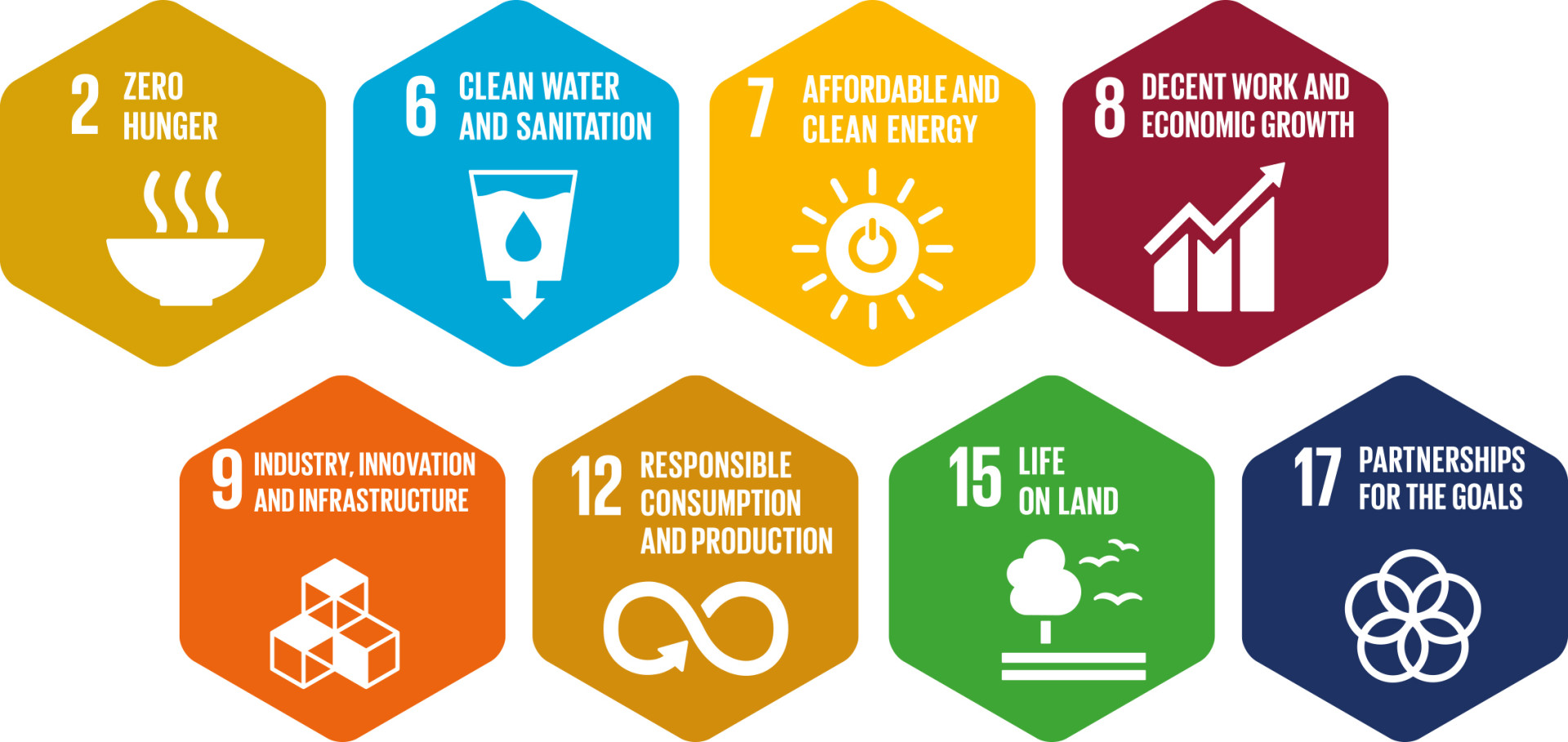
Royal Avebe aims to have a positive impact in the short and long term. We focus on long-term value creation with our activities in the supply chain and strategic targets for 2023. We link the long-term impact we have to the United Nations (UN) Sustainable Development Goals (SDGs):
2. Zero hunger
Everyone should have access to safe, nutritious and sufficient food. Our ambition to continue to grow in good food and plantbased applications contribute to this. We are also committed to sustainable growing methods, a sustainable food system and resilient agriculture.
6. Clean water and sanitation
Avebe considers it important to make efficient use of water. The water used for production is well purified. We also re-use some of the water as process water. We continue to strive for higher efficiency in water use.
7. Affordable and clean energy
We are committed to renewable energy through our solar parks. This is how we improve access to sustainable energy. We also aim to further reduce carbon emissions.
8. Decent work and economic growth
Avebe attaches importance to growers and employees being able to work under good conditions, now and in the future. We accept our responsibility for this and work on sustainable production chains.
9. Industry, innovation en infrastucture
We optimise our processes to develop cleaner and more environmental friendly technologies. We invest in innovations and improve our processes. That way, we not only create sustainable production, but also work on the digital exchange of information.
12. Responsible consumption and production
Avebe considers it important to treat raw materials and energy sustainably and efficiently. We focus on the reuse of residual flows, sustainable energy and reduction of water consumption. Our product development, focused on plant-based, also contributes to a more sustainable diet.
15. Life on land
Together with our growers, we work on the most sensible and efficient use of the available land. Our ambitions to reduce the environmental impact of cultivation contribute to this.
17. Partnerships for the goals
Avebe works actively with governments, knowledge institutions and other organisations to achieve its sustainability ambitions. This is how we can collectively achieve SDGs at local, regional, national and international level.
Annex 5 Management & supervisory board profiles
| Name | Current job | Ancillary positions |
|---|---|---|
| Cooperative board and executive committee | ||
| David Fousert | Chief Executive Officer and chair of the board | • Member of Agri & Food Top Team • Director of the Dutch Food Industry Federation |
| Rob van Laerhoven | Chief Financial Officer and member of the board | • Member of the supervisory board of Averis Seeds B.V. |
| Mark Tettelaar until 31-08-2023 |
Chief Operation Officer | • Director of the Association of the Dutch Chemical Industry |
| Klaas Hidde Kuipers from 21-08-2023 |
Chief Operation Officer | • Director of the Association of the Dutch Chemical Industry |
| Marleen de Rond-Schouten | Managing Director Agro & Strategy from 01-01-2023 | • Director Averis Seeds B.V. • Director Averis Saadsucht GmbH • Chair of Stichting Innovatie Veenkoloniën • Director of BO Akkerbouw • Director of Stichting Teeltbeschermingsmaatregelen Zetmeelaardappelen • Member of the supervisory board of Van Hall Larenstein • Co-owner VOF de Rond-Schouten Zuiderzeeevarken, Wijdenes |
| Chris Hollebek | Chief Commercial Officer | • Vice president Starch Europe from 01-06-2024 |
| Gerard ten Bolscher until 27-05-2024 |
Chief Innovation Officer | • Vice president Starch Europe • Member of the supervisory board of Next Food Collective |
| Nico Buijs | Chief HR Officer | |
| Supervisory board | ||
| Marijke Folkers SRB-committee- chair |
Co-owner mixed farm, Veendam | • Chair Agro Agenda • Chair CESPU • Chair NLB • Member of the supervisory board of ForFarmers |
| Hidde van der Wal Audit committee |
Retired | • Investor • NCD member • Member Koninklijke Industrieele Groote Club Amsterdam |
| Nanne Sterenborg Appeals committee |
Owner of arable/nature farm, Onstwedde and Romania | • CESPU member • Member TBM committee |
| Hans Wilhelm Giere Appeals committee |
Farm owner Manager of Windpark Liesten Giere GmbH &. Co. KG Manager Bürgerwindpark Wulfstorf GmbH &. Co. KG |
• Chair of supervisory board Vereinigte Saatzuchten eG VSE • Chair of the Board Viehverwertung Bevensen-Bienenbüttel eG SRB committee • Member of the board of Forstbetriebsgemeinschaft Kalbe/Milde • Chair of Bundesverband Stärkekartoffeln BVS • CESPU member • Representative member BVS at UNIKA |
| Johan Emmens Audit committee Appeals committee - Chair |
Owner of arable farm Rolde | • Member of Stichting TBM |
| Martin Möllering Appeals committee Audit committee |
Betriebsleiter Wirtschaftsbetriebe Meppen | • Member of the board of VNS (Verein Niedersächsischer Saatgutvermehrer) • Member of the board of two water and soil organisations |
| Angelique Heckman SRB-committee |
Associate partner Coredaet | • Member of the supervisory board of De Zorgboog • Member of the supervisory board ofDe Domijnen • Member of the supervisory board of Sif Group • Member of the supervisory board of Witteveen + Bos |
| Robert Smith Audit commission - Chair Appeals committee |
Retired | • Member of the board of Vereniging HZPC • Member of the supervisory board of Stichting ISPT-AF |
| Dirk Kloosterboer Appeals committee SRB-committee |
Retired | • Chair of the Supervisory Board of Bolsius International B.V. • Chair of the Supervisory BoardDarling Ingredients International Nederland Holding B.V. |
Annex 6 Terms and abbreviations
| Term | Definition |
|---|---|
| Accelerate and Strengthen | Avebe's strategy for the period 2023-2028. |
| Acreage | The total area of agricultural land. |
| AI - Artificial Intelligence |
The development of computer systems that can perform tasks that normally require human intelligence, such as speech recognition, decision-making and pattern recognition. |
| Annual Operating Plan (AOP) | Our annual plan. This plan is derived from our five-year strategy. |
| Avebe Academy | A platform that in the coming years will be equipped with practical learning modules focused on the five core competences and will allow employees to shape their own development. |
| Averis | Averis Seeds B.V., a subsidiary of Avebe, focused on the development and trade of starch potato varieties. |
| Base price | The base price is the basis of the potato money members receive for their starch potatoes. The base price is set at the beginning of the growing season. |
| Biobased | Products or materials made wholly or partly from renewable biological resources, such as plants, animals or micro-organisms. |
| Biodiversity | The variety of life in different forms on earth. |
| Campaign price | During the potato campaign, Avebe may decide to increase the price for potatoes. This depends, among other things, on developments in the market. The base price and any increase form the campaign price. |
| Carbon emission | The release of CO2 in the atmosphere. |
| Circularity | The principle whereby products, components and materials are reused after their useful life, so that no waste is created and value is preserved. |
| Clean label | A product with few additives or artificial ingredients |
| CSRD - Corporate Sustainability Reporting Directive |
A reporting guideline for sustainability reporting from the European Union for large organisations. |
| Double materiality analysis | A method to assess both an organisation's impact on the environment and society (inside-out) and the influence of sustainability issues on the organisation itself (outside-in). This helps identify relevant sustainability issues for both the organisation and its stakeholders. |
| EC - Executive Committee |
The executive committee of an organisation, responsible for the day-to-day management of the cooperative. |
| EcoVadis | A globally recognised platform that helps companies assess and improve their sustainability performance in the areas of environment, human and labour rights, ethics and procurement. |
| ESG - Environmental, Social & Governance |
A framework used to measure an organisation's sustainability and social impact. It comprises three main areas: environmental, social and governance. |
| Fermentation | A process in which bacteria, fungi or yeasts convert substances, changing acidity, taste, odour or appearance. |
| Footprint | The impact of human activities on the environment, measured in terms of pollution, damage to ecosystems and consumption of natural resources. |
| Guarantee of origin | A digital certificate proving that a certain amount of energy has been generated sustainably. The certificate contains information about the energy source, the production facility, and the production date and place. |
| Life Saving Rules | A set of safety rules designed to prevent serious injuries and fatalities. These rules focus on critical safety areas such as working at height, energy isolation, and avoiding dangerous situations. |
| LST - Leadershipteam |
Avebe's senior management. |
| Materiality analysis | Identifying sustainability topics that are most relevant to both the organisation and its stakeholders. |
| Membership fee | Members who deliver on shares receive a member surcharge of 5 euros per tonne of potatoes. This member surcharge is paid on the A and B volume. |
| Performance indicator | The performance indicator tells how Avebe is performing over the years. The performance indicator is a sum of potato money, transport costs and the cooperative result. The performance indicator is standardised on a starch percentage of 19 per cent. |
| Play to Win | An organisational culture focused on achieving maximum results through innovation, responsibility and proactive behaviour. This culture encourages employees to take risks, think creatively and constantly strive for improvement and success. The Play to win competences are: reflect, innovate, change, achieve and connect. |
| Potato money | The potato money is the amount that growers receive for their starch potatoes at the average starch percentage in the respective campaign. The potato money consists of the campaign price, the performance components and the distribution from the cooperative result. |
| SBTi - Science Based Targets initiative |
The Science Based Targets initiative provides companies with a clearly defined pathway to reduce their emissions in line with the goals of the Paris Agreement. |
| Scope 1, 2 and 3 | Scope 1: The direct emissions of greenhouse gases at a site. Scope 2: The indirect emissions caused by electricity consumption. Scope 3: The indirect emissions of CO2 caused by business activities of our suppliers. |
| SDGs - Sustainable Development Goals |
United Nations Sustainable Development Goals. |
| Sludge | A semi-liquid mass produced as a by-product of water treatment or industrial processes. |
| Social advisory council | An independent body that provides advice to an organisation on social issues and policies. |
| Tare | The sand, foliage and stones still sticking to the potatoes when delivered to the factory. |
| TRIFR - Total Recordable Injury Frequency Rate |
A measure of the number of accidents involving absenteeism in a given period. |
| Wart disease | A disease caused by the fungus Synchytrium endobioticum, which greatly reduces potato yields and makes them unsaleable. |
| WCOM - World Class Operations Management |
A management approach focused on operational excellence. |