
6.1Sustainability at Royal Avebe
In this section we report on our environmental, social and governance objectives, actions and results, usually expressed by the English terms Environmental, Social and Governance (ESG). From the 2025/2026 financial year, Royal Avebe will voluntarily report according to the new European directive: the Corporate Sustainability Reporting Directive (CSRD). This directive will bring more transparency and comparability in the sustainability performance of organisations. Thus, we are taking further and further steps in our sustainability reporting.
Sustainability in our strategy
Sustainability is a fundamental part of our Accelerate and Strengthen strategy.
With our plant-based products, we reduce the ecological footprint of our customers in the food industry and in the construction and packaging sectors. For the latter, it is also important to mention that our products are bio-based and circular. We aim to reduce our footprint in line with the Paris Climate Agreement, for our own operation and for our customers. Thus, we focus on structurally lowering our energy consumption, reducing water intrusion and the circular use of residual streams.
On the cultivation side, we are also mindful of changes in the climate. Our subsidiary Averis develops new varieties that are more resistant to drought and potato diseases, for example. But which also deliver higher yields in potato starch and potato protein per hectare us i ng fewer crop protection products. In total, Avebe has set up seven sustainability programs within the current strategy, which focus on making our entire value chain more sustainable. These programs and the set targets associated with them have been approved by the executive committee and supervisory board in the strategy process. For each program, a program manager is responsible for implementation. The program managers are accountable to the Director Sustainability. The Director Sustainability informs and reports to the Executive Committee on the progress of the overall sustainability program. Avebe's board is responsible for implementing the strategy Accelerate and Strengthen, which is supervised by the supervisory board. At least once a year, the board reports on the implementation and status of the strategy to the supervisory board. Read more about the Accelerate and Strengthen strategy here.
Science-based Targets initiative
Besides embedding sustainability in our strategy, our climate ambition is also visible through our commitment to the Science Based Target initiative (SBTi) this year. This involves setting and having emissions targets validated in line with the Paris Climate Agreement, which aims to keep global warming below 1.5 degrees Celsius. Our commitment to the SBTi shows our confidence in a more sustainable future with specific targets and action plans towards the 2030 climate goals.
Gold EcoVadis score
Avebe achieved another gold EcoVadis score in 2024. This recognition places us among the top 5 per cent of assessed companies in our sector. EcoVadis internationally assesses sustainability performance in the areas of environment, human and labour rights, ethics and procurement. Through collaboration with suppliers and customers, Avebe strengthens sustainability performance throughout the chain. At Avebe, we work continuously to improve sustainability. The gold EcoVadis score is a confirmation of these efforts for the whole organisation.
6.2ESG Governance
ESG is integrated into Avebe's governance structure. Here we also refer to the Corporate Governance chapter in this annual report, where we explain the main elements of our governance structure.
ESG-CSRD project group
In October 2022, we started the ESG-CSRD project with a project group
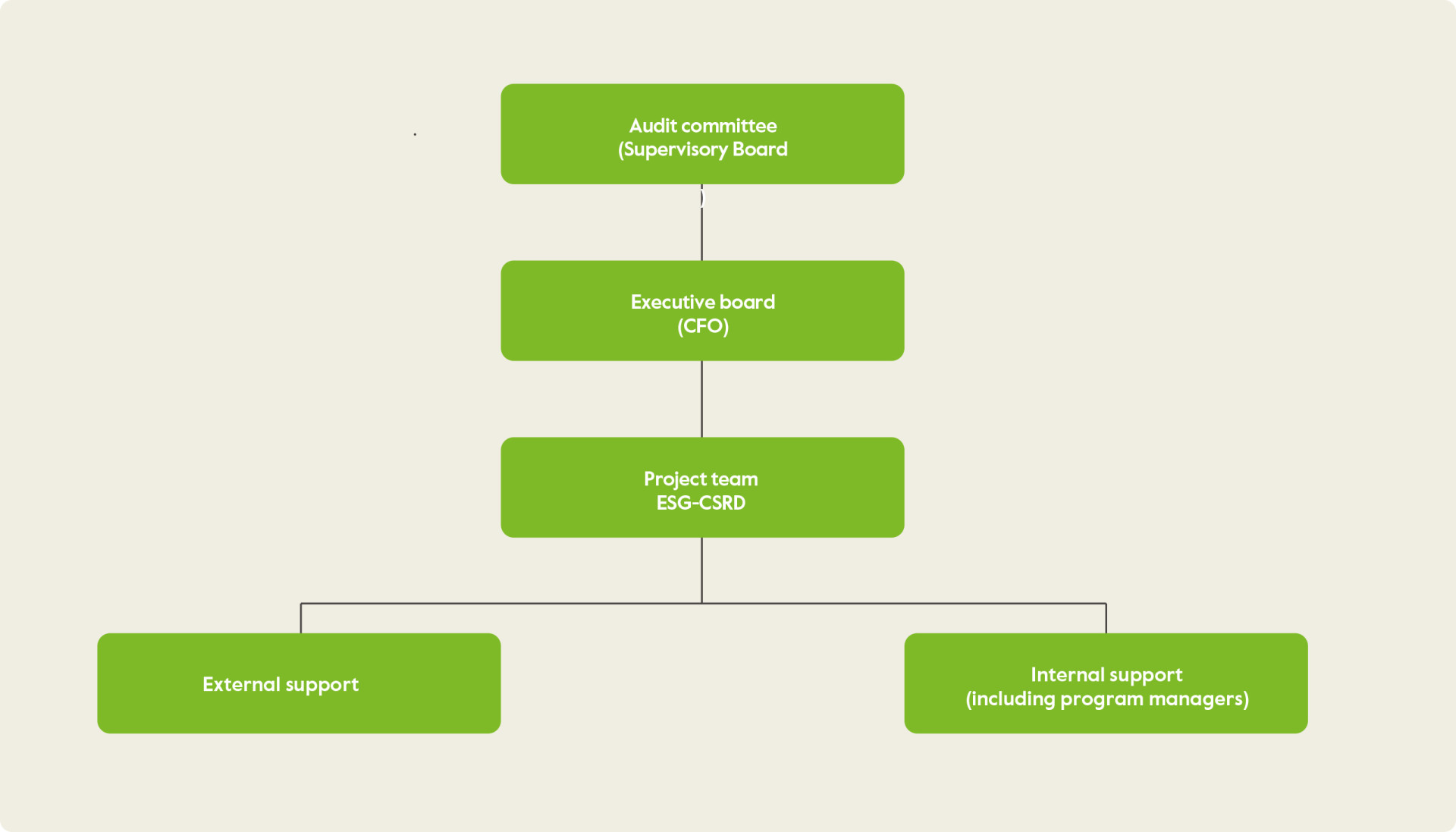
The project team from Avebe consists of staff from the Finance, Internal Audit and Sustainability departments. This under the responsibility of the Chief Finance Officer (CFO). Furthermore, a broad group of internal experts within Avebe is involved in the process. We also make use of external support. Below is the organogram of the project structure:
As a first important step, a dual materiality analysis (DMA) was conducted to identify the material ESG topics for Avebe.
Securing required sustainability knowledge
The board of directors, executive committee and supervisory board attend several meetings each year where sustainability topics are discussed. These include both internal and external meetings. The program managers report on the material impacts, risks and opportunities they see in their strategic program. Other topics discussed include sustainable agriculture, energy management, biodiversity, waste, transport and (future) laws and regulations.
In addition, within Avebe, the sustainability strategy is fully integrated into the planning and control cycle. This means monthly reporting to the board, the executive committee and the supervisory board on key performance indicators related to sustainability. The knowledge carriers in the fields of water, energy, circularity, sustainable procurement and sustainable agriculture also periodically share knowledge from the strategic sustainability programs with the Executive Board and the Executive Committee.
Furthermore, specific knowledge in the field of sustainability, developments therein and also applicable laws and regulations is vested in the Sustainability department and the ESG-CSRD project team. From here, we report periodically to the Management Board and the Supervisory Board on the progress of the implementation of CSRD, important developments in the field of ESG and monitoring on performance indicators in relation to sustainability.

6.3Double materiality analysis
Periodically, we use a materiality analysis to determine which topics our stakeholders find most impactful for Avebe. From the Global Reporting Initiative (GRI) standards, only outward impact, Avebe's influence on its environment, is included for determining material topics. To properly prepare for the requirements of the CSRD, we conducted a double materiality analysis last financial year.
Dual materiality
A dual materiality analysis determines which sustainability topics are most important to an organisation. As the name suggests, this analysis is carried out from two different perspectives. On the one hand, an outward impact analysis, which determines Avebe's impact on its surroundings (people and environment) with regard to a specific theme. This impact may be caused by Avebe in its own operations, but Avebe may also be associated with the impact. In that case, the impact happens in the organisation's value chain. And on the other hand, an analysis of the impact inwards. This looks a t the financial consequences for Avebe related to a theme. Thus, a sustainability theme is assessed from two perspectives. The higher the score, the more important this theme is for our cooperative.
Process
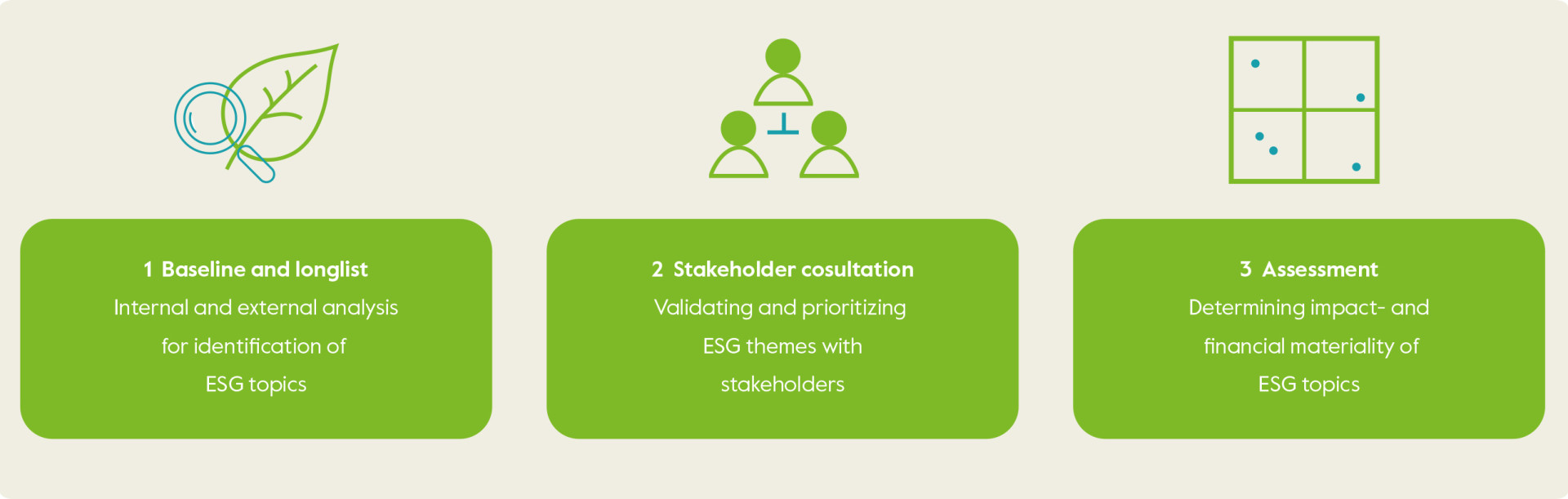
The steps Avebe went through to arrive at the material topics are shown visually below:
Step 1: understanding context and list topics
For our materiality analysis, we mapped Avebe's environment. This includes understanding our value chain, our value creation model and the identificating stakeholders. Our main stakeholders are: our members, employees, customers, suppliers, credit institutions and regulatory bodies. Other stakeholders with whom we actively engage in dialogue and cooperation include knowledge institutions, social organisations, NGOs, residents of our production sites and industry organisations, such as VNCI and BO Akkerbouw. Furthermore, we take into account other stakeholders whose interests may be affected by Avebe's activities and its direct and indirect business relationships within its value chain.
We then drew up a list of potential material topics (longlist). Through internal analysis, we reviewed and adapted the longlist from the new Accelerate and Strengthen 2023-2028 strategy and discussions with the sustainability programs' program managers. We c ondu c t ed the external analysis based on a desktop review. In doing so, we consulted known and available sources including (draft) standards and guidelines. Furthermore, we reviewed publicly available information from suppliers and peer companies, taking i n to account company size, type of companies and sustainability maturity. The outcome of these analyses resulted in a list of potential material issues for Avebe.
Step 2: stakeholder dialogue and prioritisation
In two comprehensive workshops, one focused on environmental topics and the other on social- and governance-related topics, we worked with internal experts and external advisers to assess the potential internal and external impact of the material topics. In identificating the impact, we took into account both Avebe's own impact and the indirect impact arising from our supply chain. We also assessed and discussed the severity of the effects, taking into account their scope, scale and irreversibility. Financial risks and opportunities were assessed based on their likelihood of occurrence and their potential financial impact on Avebe. We determined the potential financial impact by looking at the size of possible financial gains or losses. We measured this by identifying the change in resources available to Avebe (natural, social and economic). Following this, we prioritised topics for both impact materiality and financial materiality. In the discussions, we took into account the actual and potential impacts for the coming year, but also for the next five years and beyond. The scores and prioritisation as a result were recorded by the project team. Based on this, a shorter list of material topics was drafted (shortlist).
Step 3: outcomes validation
The outcomes from the workshops were then presented and discussed in the Social Advisory Council (MAR). The MAR includes representatives from key stakeholder groups. Through the MAR, we gather insights from interested stakeholders to arrive at new insights or test ideas. In this session, a diverse group of external stakeholders was present (government, NGOs, university, business, farmers), but there were also internal stakeholders, e.g. from the management and supervisory boards. The final scoring and outcomes were determined based on input from project team, workshop sessions, discussions with the MAR and other work. The outcomes were then submitted to the executive committee, audit committee and supervisory board for validation and thus made definitive.
Below is an overview of the outcomes from the dual materiality analysis. We explain the various topics in more detail afterwards. Together with our stakeholders, we continue to monitor and validate the material topics. The elaboration of the material topics and the action plans are also monitored and adjusted where necessary

6.4Material issues
| Subject | Materiality |
|---|---|
| Environmental | |
| Climate change mitigation | Impact and financial material |
| Energy management | Impact and financial material |
| Resource security | Impact and financial material |
| Water abstraction | Impact and financial material |
| Water pollution | Impact and financial material |
| Circular waste streams | Financial material |
| Plant-based products industrial | Financial material |
| Social | |
| Safe working | Impact and financial material |
| Food safety | Impact material |
| Attractive employer | Impact and financial material |
| Plant-based foods | Impact and financial material |
| Governance | |
| Business ethics | Impact and financial material |
6.4.1 Climate change mitigation
Impacts, risks and opportunities
Climate change from the focus on CO2 reduction impactsboth our own operations and our value chain. Producing (modified) starch and protein costs energy and therefore results in CO2 emissions. This concerns both our own emissions and indirect emissions. Our main risks are climate-related regulatory changes, as are regulations to reduce emissions in production and agricultural activities. There are also (substantial) costs associated with high CO2 emissions, for example by having to purchase CO2 allowances. By saving energy and a (cost-efficient) switch to sustainable energy sources, we can reduce CO2 emissions.
Strategy
Our Accelerate and Strengthen strategy includes our sustainability targets for 2030, as that year is a key measuring point towards climate neutral in 2050. Avebe's ambition is to have CO2 reduction targets in line with no more than 1.5 degrees Celsius of global warming, in line with the Paris Climate Agreement. We have committed to the Science Based Target initiative (SBTi) and are now in the process of aligning our targets with the SBTi criteria. We are targeting a CO2 reduction target of 30 per cent for the period 2023-2030, with 2022/2023 being the baseline year. This is the target for scope 1 emissions (direct greenhouse gas emissions from our operations). Scope 2 emissions (indirect emissions from electricity consumption) from Avebe are already 0 and the target for 2030 is to remain so.
For our scope 3 emissions (indirect emissions of CO2 , caused by business activities of another organisation), we also have the ambition to reduce 30 percent. By making this scope distinction, we are in line with the way governments formulate targets for the reduction of greenhouse gases. We have included in the strategy the CO2 and energy reduction program 'Towards climate neutral', and scope 3 is included in the 'Sustainable procurement' program.
Approach and action plans
From the strategic program, a concrete plan has been drawn up to meet the reduction targets for scope 1 (and 2) emissions. This plan is divided into two parts: 30 per cent reduction by 2030 with underlying a plan of action with concrete required measures and investments. One example is theplanned investment in an electric steam boiler at our Foxhol production site in 2024. We are also looking for other improvements in our processes and activities, for example from our World Class Operations Management (WCOM) program, which aims to further efficiency and effectiveness of our production processes. This will enable us to save around 1.5 per cent of energy (and also CO2 ) per year. For the goal of climate neutrality in 2050, we have mapped out options for Avebe to produce entirely CO2 -neutral. We are closely following developments in this area. The first steps towards electrification have been taken by implementing membrane technology and e-boilers. There are plans for further electrification. Grid congestion is a potential bottleneck in this respect. Currently, two solar farms at Avebe sites are already connected through Avebe's electricity grid.
We are investigating what opportunities there are for further connection of local renewable electricity production. We are now mapping our scope 3 emissions. At the same time, we have already started to make savings by, for example, taking this into account in tendering processes with suppliers. In the coming year, we will continue to look for opportunities to reduce, reuse or recycle packaging. We are also looking at ways to reduce the impact of internal transport and seeking sustainable partnerships for external transport.
Goals and realisation
The following targets have been set for 2030: CO2 - reduction target of 30 per cent for scope 1 and scope 3 and a scope 2 emission of 0.
In FY 2023/2024, scope 1 CO2 emissions were 160 kilotonnes and 0.20 tonnes of CO2 per tonne of product. The scope 2 CO2 emissions were 0. This concerns the emitted CO2 (scope 1 and 2) corrected for what was produced for third parties (other companies on site). The emission factor for Guarantees of Origin (GOs) for green electricity was set at 0. The scope 1 CO2 emissions are 19 percent lower than last year. This is largely explained by the lower production volumes in this financial year. However, scope 1 CO2 emissions per tonne of product were 4 per cent lower, in line with our targets.
6.4.2 Energy management
Impacts, risks and opportunities
We have translated energy management into the availability, affordability and consumption of energy at Avebe. Excessive costs make us vulnerable because we use a lot of energy. Because we use a lot of energy, and because of the resulting CO2 emmisions, we have a negative impact on the environment and climate change. A key risk is climate-related changes in laws and regulations. This can result in rising costs for energy consumption. It can also cause problems in obtaining permits for future investments. In addition, grid congestion may pose a risk with regard to the future availability of electricity, especially if, in the course of the energy transition, our cogeneration plants are phased out.
Strategy
Energy management is strongly linked to the theme of climate change, see the 'Mitigating Climate Change' theme above. For the new strategic period 2023-2028, we have set sustainability targets for 2030, as that year is an important measuring point for us. Apart from CO2 reduction, we aim at least 1.5 per cent on energy consumption at each production site every year. We have included in the strategy a CO2 and energy reduction program 'Towards climate neutral'.
Approach and action plans
Improving energy efficiency is part of the WCOM program. The basis for this is expansion of inline energy metering and local energy dashboards for monitoring energy consumption. In addition, a number of energy-saving investments are planned in the multi-year investment plan. For the availability of sufficient electricity in relation to the grid congestion issue, we are investigating opportunities for further connection of local renewable electricity production to Avebe's grid in addition to the already connected solar farms at Avebe sites.
Goals and realisation
Heading towards 2030, the following target has been set: save 1.5 per cent of energy consumption annually.
In financial year 2023/2024, total energy consumption was 758,372 MWh. Total energy consumption is 16 per cent lower than the previous year. This is largely explained by the lower production volumes in this financial year. Despite the lower production volumes, energy consumption per tonne of product was 1.1% lower than last year, in line with our strategic targets.
6.4.3 Resource security
Impacts, risks and opportunities
Avebe's members face additional agricultural policies, the effects of climate change, high growing costs and competition in the f ield with other crops. These factors affect Avebe's short- and long-term supply of raw materials. Avebe needs to gain early insight into the possible changes in raw material supply and manage accordingly with a good payout for members, robust potato varieties and take its role towards a sustainable starch potato crop. Insufficient steps in this gives the risk of loss of attractiveness of starch potato cultivation. Lower volume of starch potatoes also has financial impact as it affects, among other things, the coverage of our plants and potential sales volumes.
In addition to the risks mentioned above, Avebe's required cultivation by its members also has an indirect impact on the environment, and we are committed to reducing the impact and adapting to climate change. The cultivation of starch potatoes has an impact on climate, water and soil, among other things. Developments in this area include experimentation and education on new, more sustainable cultivation techniques and providing appropriate support for the introduction of new varieties bred by our breeding company Averis.
Strategy
We constantly monitor the development of Avebe acreage in the short, medium and long term and anticipate this with our added value strategy in the market. Our aim is to improve the financial attractiveness of cultivation at an accelerated pace and in large steps and to maintain potato starch acreage at a l e v el that is healthy for the cooperative.
Furthermore, we actively work (together) with our members and chain partners on profitable and sustainable starch potato cultivation. This is all about yield and return in a sustainable cultivation plan. We keep the soil healthy, limit the impact on nature and the environment and promote positive effects as much as possible.
All this should fundamentally ensure a good payout price for our members' potatoes. This is essential to secure the raw material supply for Avebe. Our strategy includes the following objectives for this purpose:
- keep the starch procurement/area at strategic level;
- lower footprint in our farmers' cultivation;
- intensify the support process for new varieties.
Approach and action plans
We are committed to improving disease resistance of our Averis varieties, breeding and promoting robust varieties with less impact on the climate (e.g. through reduced required nitrogen application), our current business set-up with organised transport and our reliable image as a potato starch processor.
Avebe facilitates the exchange of knowledge and experience on topics such as climate, soil, water, crop protection and weed control. We proactively support our members in finding answers to crop challenges that come their way and to which we, as a cooperative, want to and can contribute.
Targets and achievement
To track our strategic objectives, the following targets have been set:
- Development of performance indicator up to and including financial year 2027/28 by +€25;
- 5,000 hectares of acreage with new Averis varieties;
- 50 active participants in the Pilot Biodiversity Monitor* and working towards national coverage within arable farming.
Over the past year, the performance indicator stood at €118.62, a step down from last year but underlying, we see the right steps to continue the strategic development.
By crop year 2023, a total of 8,706 hectares of potato starch acreage has been planted with the 11 new Averis varieties on the market.
There are currently 37 active participants in the Biodiversity Monitor, see further box included here.
*Pilot Biodiversity Monitor
In Drenthe, 37 arable farmers participate in the Biodiversity Monitor. They are s c or i ng organic matter balance, environmental impact, soil cover, crop diversity and nature and landscape management. The farmers are taking part to gain more knowledge about more sustainable cultivation, and ultimately participation should result in a plus on the balance sheet.
6.4.4 Water withdrawals
Impacts, risks and opportunities
Avebe draws in a lot of water for the production process. But on net, we return more water to the environment because a starch potato contains a lot of water. The risk and impact are particularly in the necessary intake of water for our production process. There is more ecological and social pressure on the use of water, partly due to dry summers. Water is necessary for our production process. Water scarcity is a risk for Avebe. If we cannot withdraw enough water, it might lead to reduced production or even production stoppages.
Strategy
To reduce the impact of our operations, we have for years set targets for reducing our intakes of water. Avebe has included the importance of reducing water withdrawals and using them as efficiently as possible in the program 'Every drop counts', which is part of the strategic program Plant-based sustainable growth.
Approach and action plans
To meet our targets, we are particularly committed to reducing salinity in wastewater. Read more about this in the material topic 'Water pollution'. We are in the process of drawing up concrete plans for each production site. For our largest production site, the plan of action has been finalised. Furthermore, we continue to focus on stable operations to minimise water requirements. We also aim to optimise cooperation between our production sites to reduce water requirements.
Goals and realisation
A 30 per cent saving in 2030 compared to the reference year 2022/2023, equivalent to 6 million Mm3 of water, was included as a central target. In the 2023/2024 financial year, total water abstraction was 13.2 Mm³, which is 17 per cent less than in the previous financial year (15.9 Mm³). This volume in million m³ (Mm³) refers to the total of drinking water, well water and surface water from Avebe's six production sites. Water withdrawal decreased in the 2023/2024 financial year. This is mainly due to our product mix: the production of less modified starch and potato protein leads to the use of less water.
6.4.5 Water pollution
Impacts, risks and opportunities
The last strategy period (Binding and Building 2018- 2023) showed that reducing water abstraction without considering other processes leads to higher concentrations of salt in our wastewater. This leads to salinisation of the water bodies where we discharge our wastewater. Both our purification processes, especially within potato protein production, and much of our starch modification processes lead to high concentrations of salt in wastewater. We now save so much water that further reduction of our water intake is not possible without reducing the amount of salt in our wastewater. This means we need to look at both our (protein) purification and our starch modification in a different way.
We need to contribute to the local availability of water and government standards for water runoff are likely to be further tightened in the coming years. This involves risks, such as investments to continue to meet future requirements.
Strategy
Avebe has included the importance of water outflow in the 'every drop counts' program, as part of its strategic program Plantbased sustainable growth. Our goal is to facilitate Avebe's desired growth while remaining compliant with permits. The strategic goal for 2030 is to reduce enough salt so that we can achieve our water conservation ambition.
Approach and action plans
For each production site, we started making a plan in the 2023/2024 financial year that focuses on saving water by reducing the amount of salt. The solutions will be product-specific and we look at each site.
6.4.6 Circular waste streams
Impacts, risks and opportunities
Important waste streams for Avebe are sludge and tare. We process the wastewater from our processes in wastewater treatment plants. This creates sewage sludge. By the growth of our vegetable protein products, we produce more wastewater and therefore more sewage sludge. Currently, sludge is a residual stream with a negative value for Avebe, mainly because it can contain heavy metals, which means we cannot always use it in a circular way and therefore have to pay a fee for its disposal.
In addition, when potatoes are delivered to our factories, sand, foliage and stones come along unintentionally. We call this tare. Tare is a waste stream because it is difficult to find a valuable or low-cost application for it. The circular application of residual flows and reducing costs is therefore a financial opportunity for Avebe.
Strategy
Avebe produces residual streams with a net negative economic value. Our goal is to avoid these residual streams or find applications where we can (re)use these residual streams at the highest possible value. This will result in minimising or eliminating the use of primary (new) raw materials, thereby increasing Avebe's circularity. In our Accelerate and Strengthen strategy, we have included a number of targets in relation to our residual streams in our program 'increasingly circular':
- set up internal reporting around 'resource use and circular economy';
- minimise the use of primary raw materials;
- improve the operating margin of our residual streams.
Approach and action plans
Initially, we identified the net negative value for Avebe for the various residual streams, set specific targets for each residual stream and then, based on a positive business case or a 'licence to operate' float, drew up a concrete plan for valorising or minimising the residual streams. These plans will be further geëffected in the coming years, such as certificating sludge from our production and originating from agriculture as fertiliser.
Goals and realisation
Valorise residual streams with a net negative value to increase circularity up to 2030 with the following concrete goal:
- 30 per cent cost reduction compared to the 2022/2023 baseline year.
Currently, these targets are being further elaborated and specified to collect the right data. In terms of volumes, the following has been achieved for tare and sewage sludge:
- In the 2023/2024 financial year, total sewage sludge (gross weight in tonnes) was 71,876, 30 per cent less than in the previous financial year (103,041), mainly driven by lower production volume.
- In the 2023/2024 financial year, tare (>#/span### tare of potato weight) was 6 per cent, which is 32 per cent more than in the previous financial year (4.6 per cent). Weather conditions during harvest had a major negative impact on the tare rate.
6.4.7 Plant products industrial market
Impacts, risks and opportunities
Our industrial customers are looking for better, cleaner alternatives from the (consumer) market demand for more sustainable products. Avebe plays an important role in the consumer demand for plant-based alternatives, because with potatoes we have a unique raw material and the application knowledge. We have and are developing a portfolio of products that responds to this. As Avebe, we have the opportunity to expand our place as market leader in sustainable ingredients for industrial applications.
Strategy
We have a clear strategy to use our product offering to maximise Avebe's added value in the vegetable construction and food packaging industries. We do this by achieving volume and margin growth in the two segments mentioned above, by focusing on vegetable and sustainability trends and working with our customers on product solutions from our raw material base.
Approach and action plans
We work from a collaborative approach to commerce, market development and marketing. Specifically, this runs through the following action plans.
- From business development, define areas where Avebe's products and expertise can offer a unique solution;
- Work with customers to identify their specific requirements and wishes and collaborate on solutions.
Goals and realisation
Currently, a process has been started to formulate concrete goals so that the right data can then be collected and discussed about this can be reported.
6.4.8 Working safely
Impacts, risks and opportunities
Safety has been a key focus within Avebe for many years. We want all employees, suppliers and visitors to be able to do their work safely and go home safely. Despite this, accidents happen and have a negative impact on the safety and health of employees. A lack of safety measures creates risks for the individual and for Avebe as a whole. These consequences include production stoppages, penalties, legal liability and loss of reputation. This can damage confidence in Avebe and its products and thus negatively affect our revenues.
We strive for a safe workplace to effectively manage risks. Productivity and efficiency of processes also improve when employees and visitors are well aware of safety rules and protocols.
Strategy
Safety is part of the healthy breeding ground of the Accelerate and Strengthen strategy and therefore embedded in our operations. We strive for a safety culture based on trust, credibility and transparency. Our main objectives in this are:
- minimising injuries and other safety incidents;
- ensuring the continuity of our business operations;
- developing authentic leadership in line with Avebe's core competences.
Our ultimate goal is to minimise the number of incidents, preferably having zero safety incidents. Read more about our Accelerate and Strengthen strategy in chapter 4.
Approach and action plans
We take the following approach:
Behaviour-based safety programme
In this financial year, we started implementing a behaviour-based safety program across the organisation entitled 'Life Saving Rules'. These rules are a set of very important agreements and practices that we, as Avebe, do not compromise on. This means that we always follow the Life Saving Rules, even when it can be difficult or lead to loss of production. If we do, you yourself but also your colleagues can go home safely at the end of a working day. The rules behind the Life Saving Rules concept already existed, but were sometimes formulated too generally. Strict adherence to requirements means we need to create clarity in these requirements and then solve the barriers that employees encounter.
Safety training
We have reviewed the existing training matrix and made additions for various positions as to what training is necessary to work safely and responsibly. We train our employees on safety topics at least once a year. We offer these via our internal digital learning platform and they are compulsory in nature. This way, we enforce that every employee can work on site with the right knowledge on safety.
Digital work permits
Part of the 'Life Saving Rules' is improving the quality of the work permit. A work permit defines how safe maintenance work can be carried out. In this context, we have introduced a digital work permit process at all Dutch production sites, which has replaced the paper version. The major advantage that a digital work permit process offers us lies in the mandatory workflow with mandatory fields and the use of checklists that are 'automatically' invoked depending on activities. Besides being mandatory, this helps us make our employees' work easier.
Goals and realisation
For the 2023/2024 financial year, Avebe's target is an accident frequency index TRIFR (Total Recordable Injury Frequency Rate) of 0.8. The TRIFR is an international standard based on the number of incidents per 200,000 hours worked at our sites. This target applies to all Avebe employees and others working at our sites.
The TRIFR outcome in 2023/2024 was 0.9, slightly higher than the target, but 0.2 better than the previous year. There were no fatal accidents or accidents with serious consequences involving a recovery period longer than six months. The top three incidents were falls and trips, exposure to chemicals and cutting. Analysis of these incidents shows that many are preventable by strengthening the basics. For example, by clearly communicating the Life Saving Rules.
6.4.9 Food safety
Impacts, risks and opportunities
For years, there has been a growing awareness of sustainability, health and also stricter food legislation; often translated as food safety. Although we do not supply end consumers directly, we do have a great responsibility to supply products that meet the quality standards and legislation around food safety. If problems occur in relation to food safety, this has a negative impact on our customers and/or environment. There are health risks associated with quality standards that are not met. Through internal and external audits, Avebe is FSSC22000 certified as a food-safe producer/supplier. The requirements are getting stricter and food safety problems can lead to health damage, reputation damage and reduced confidence in our products.
Strategy
Safety is part of the healthy breeding ground of the Accelerate and Strengthen strategy and therefore embedded in our operations. We strive for a safety culture based on trust, credibility and transparency. Our main focus on food safety is ensuring food safety compliance in line with laws, regulations and customer requirements.
Read more about our Accelerate and Strengthen strategy in chapter 4.
Approach and action plans
We take the following approach to implementing our food safety strategy:
Building a food safety culture
Avebe continues to build on strengthening a food safety culture. Building a food safety culture goes beyond implementing food safety protocols and procedures; it emphasises integrating a safety mindset into employees' daily practices and attitudes. A strong food safety culture includes a commitment from everyone in our organisation to prioritise and maintain food safety standards. This means attention to hygiene, cleanliness and compliance with established food safety rules and guidelines. From the central QESH (Quality, Environment, Safety and Health) organisation, unambiguous compliance with these rules and guidelines is ensured through clearly defined procedures and work instructions.
Internal and external audits
In addition to the external audits conducted annually on our food safety certification, Avebe is strongly committed toadditional food safety compliance audits by the internal audit department.
Goals and realisation
We aim to minimise the number of recalls related to food safety, with a target of 0 recalls. We also want to reduce the number of (major) external audit findings, with a target of 0 findings.
This financial year saw two recalls related to food safety. In the first, insect particles had been observed in the product produced at one of our toll producers. To prevent potential risks related to food safety, this batch was recalled. The situation normalised and had no further consequences. The second incident was related to the use of a processing aid not known to the customer. Although the dosage of this processing aid was in line with laws and regulations and did not create an obligation for us to declare, we failed to inform our customers sufficiently well regarding the residues (possibly) present.
This financial year also saw an external audit finding. This related to the animal feed audit in Ter Apelkanaal and concerned a minor finding from an earlier audit that was insufficiently followed up the following year. This finding is now no longer present due to appropriate follow-up.
6.4.10 Attractive employer
Impacts, risks and opportunities
The composition of the workforce, now and in the future, is crucial. Avebe will see an ageing workforce in the coming years, while there are shortages on the labour market for several professional groups. In addition, the world is changing faster than ever before; rapid digitalisation and artificial intelligence (AI), climate change, a 'challenge for talent' and competition on arable land. Ensuring sufficient numbers of high-quality skilled staff and then developing and retaining them requires considerable efforts. Insufficient attention to this may lead to loss of attractiveness on the labour market and an inefficient organisation. In addition, as an employer, we have a major impact on our employees. Our impact is focused on providing an inclusive working environment and facilitating employee development.
Strategy
To keep Avebe strong and future-proof as an organisation, we have set up the overarching strategic program 'Strengthen the organisation'. This program looks at further establishing an organisation that makes best use of the talent of our people. It includes the following objectives:
- effective Play to Win leadership supported by an integrated leadership development program, tailored to the different levels, personal development plans and appropriate to the future organisational set-up;
- efficient and effective design of the organisation with the right people in the right place at the right time including an understanding of the required skills and competences;
- the Avebe Academy as a learning platform where talent management, training, personal development and compliance requirements come together;
- a recruitment and selection policy in line with the future design of the organisation and our diversity policy.
Approach and action plans
We adopt the following approach and action plans for strengthening our organisation:
Leadership development program
A leadership development program for Avebe has been designed and is under implementation, focusing on personal leadership and development. All executives, the Executive Committee (EC), Leadership Team (LST), Management Group and all team leaders in the Netherlands participate in this program. The program focuses on leadership development based on Avebe's five Play to Win core competencies: reflect, realise, connect, change and renew. The program aims to strengthen authentic leadership and create one Avebe; we implement this at different levels within the organisation based on the Play to Win concept.
Avebe Academy
We started developing and setting up the 'Avebe Academy' in this financial year. In the coming years, this platform will be equipped with practical learning modules focused on the five Play to Win core competences and will allow employees to shape their own development. Among other things, we offer workshops, training courses, internships, special projects and other (online) learning opportunities, linked to personal development plans and job-related curriculums.
Strategic personnel planning
We take into account the most optimal structure of our organisation within our strategic formation planning process. We do this by aligning the organisational structure with our objectives, with the ultimate goal of improving efficiency and effectivity; operational excellence. Drivers behind the organisational design are digitisation/ automation of processes, the right span of control of the management layers and the urgency to improve our organisation (a little) every day. In short, an organisation ready for the future; an agile, efficient and effective Avebe.
Recruitment and selection program
We are working on a recruitment program that focuses on career paths, social contributions and personal development to attract the right workforce and leaders of the future, in line with our expected organisational set-up. We are also aligning our recruitment program with the diversity policy and establishing an effective and future-proof recruitment process.
Goals and realisation
This has translated into the following targets for financial year 2023/2024, among others:
- net average absenteeism below 5 per cent;
- conducting an employee satisfaction survey (MTO) every two years;
- mandatory training/e-learning 90 per cent on time and fully completed;
- at least 18 per cent of our management positions occupied by a woman;
- securing an integral leadership program related to our values, core competences and Play to Win behaviours.
The realisation in financial year 2023/2024 is as follows:
- net absenteeism 5 .0 per cent;
- MTO is scheduled for autumn 2024;
- mandatory training/e-learning 83.3 per cent completed on time and in full;
- 20 per cent women in senior management positions;
- all executives went through an intensive leadership program of six training days and several intervision moments.
6.4.11 Plant-based nutrition
Impacts, risks and opportunities
Global demand for more sustainable, nutritious and natural products is rapidly increasing. The plant transition is a key component in reducing climate-related emissions. This is an important opportunity for Avebe. Our arable cooperative is at the heart of this changing and growing market. With potato starch and protein, we can offer unique properties and our customers can achieve their goals by offering sustainable and plant- based products to consumers. As a market leader in the production of potato starch and protein products, Avebe bears a responsibility in accelerating the transition to more plant-based. With our strong foundation and influence in the chain from 'sand to customer' and our commitment to sustainability and innovation, we are a powerful player in this transition. We are proud of the role we are playing towards healthier, more sustainable and plant-based food and the positive impact we are making.
We constantly see new opportunities to meet the changing needs of our customers and consumers from innovative solutions and from a sustainable and transparent supply chain.
Approach and action plans
Both strategic programs include speciic products and applications in which we aim to achieve sustainable growth in vegetable solutions with potato starch and protein for the food industry together with our customers.
Strategy
In our Accelerate and Strengthen strategy, two strategic programs specifically target growth in plant-based food products: 'Good food++' and 'New applications'. The first focuses on accelerating and strengthening the commercialisation of our current good food portfolio by working with (potential) customers on plant-based solutions. The New applications program also focuses on adding value to our potato starch and protein products in new applications in the food industry.
Goals and realisation
We want to accelerate sales of our potato starch and protein solutions in both existing and new applications. In doing so, we focus on an optimal mix of customers and applications. We offer solutions to help customers transition to plant-based products. Our objectives have been translated into specific growth targets in sales volume and contribution margin per product. A process has currently been started to set concrete targets so that the right data can then be collected and reported on.
6.4.12 Business ethics
Impacts, risks and opportunities
Avebe stands for fair and transparent business practices. This means that we carefully manage the interests and rights of employees, suppliers, farmer members, customers and our environment. An appropriate corporate culture is crucial in this respect. This translates into being a reliable employer, supplier and partner, and gives Avebe a good social role and position. We also stand for responsible lobbying activities and contacts with local and national politics. For us, business conduct and responsible lobbying is very important. Good business ethics allow us to distinguish ourselves positively within our sector. One risk is that Avebe is not seen as a company that advocates honest and transparent business practices.
Strategy
The cooperative is known as a transparent and democratic form of enterprise with a long-term strategy. That is why Avebe applies the principles and best practices contained in the Governance Code of the National Cooperative Council. This increases the transparency and quality of governance and supervision in our cooperative.
Doing business with honesty and integrity and with respect for people and the environment is central to us. This cannot simply be captured in procedures and guidelines. That is why we are committed to a culture of respect and trust, where there is no room for undesirable behaviour and non-integrity. We actively propagate associated norms and values and provide employees with channels for questions or reports. Our approach is implemented by offering training courses, independent confidential counsellors and complaints procedures, among other things. All this rests on a solid foundation of policies and procedures that set out Avebe's norms and values.
Corporate governance policy
Our organisational structure, our values and business principles and standards of behaviour we apply towards stakeholders are included in our Corporate Governance policy. All codes of conduct are shared with employees and can be found on our website.
SpeakUp and whistle-blower scheme
Avebe has a SpeakUp scheme that allows anyone to anonymously report serious violations that cannot be reported in any other way. This can be done both by phone and via a secure website, without the intervention of a human operator. Avebe also operates a whistleblower scheme.
Responsible Sourcing Policy
We have a responsible procurement policy, with requirements to our suppliers from Corporate Social Responsibility (CSR) firmly embedded in it. In our view, this is crucial for the way we do business. Responsible procurement and outsourcing is one of the most important factors contributing to our CSR. The way we do business should improve the lives of the people in our supply chain and not harm the environment unnecessarily. Our Responsible Sourcing Policy (RSP) provides the guidelines we follow and describes the responsibility we take on in our supply chain. Corporate Social Responsibility is an integral part of our business activities. This Responsible Sourcing Policy is fully in line with our Corporate Governance Code. We require our suppliers to comply with the principles included.
Approach and action plans
We take the following approach in relation to business ethics:
Business conduct training
Employees receive online training in responsible business behaviour. We offer these via our internal digital learning platform and are mandatory in nature. For example, there is a training course 'Competition' that deals with competition law and how to deal with suppliers, competitors and other external partners. An example of another training is 'Avebe: vision, safety and responsibility', which informs employees about Avebe's policy, strategy and various rules. It covers topics such as: internal code of conduct, discrimination, whistleblowing, working conditions, absenteeism, privacy and social media.
Sanctions policy
Avebe has a sanctions policy whereby all our customers and suppliers are automatically screened daily against the current international sanctions lists.
Stakeholder management and engagement
Avebe is actively engaged in advocacy and lobbying work for our farmer members and the cooperative on agricultural laws and regulations, water, energy transition and the future of crop products. Our efforts focus on:
- Agriculture: Avebe is involved in agricultural policy-making and regulation. We strive for a balanced approach that considers both the interests of our farmer members and their earning power, the sustainability of our products and making agriculture more sustainable while ensuring the achievement of national and European targets.
- Water: Avebe is involved in water-related policy-making and regulation. This includes water quality (including the Nitrates Directive and the Water Framework Directive), as well as the displacement series and water availability of our production sites. We aim for a balanced approach that safeguards both the interests of our farmer members and their earning power, as well as sustainability and the achievement of national and European targets.
- Energy transition: Avebe supports the transition to sustainable energy sources and is working towards a more efficient use of energy within our processes. We follow developments in the Energy Act and implement measures to reduce our carbon footprint, throughout the chain.
- Plant-based future: as a producer of potato starch and protein, we contribute to the transition from synthetic and petrochemical products to plant-based alternatives. In this, Avebe also collaborates with peers and stakeholders to promote innovative solutions, as in the Fascinating program.
Attached is our stakeholder table, in which we further explain our commitment to these topics.
Goals and realisation
We want to build a strong foundation on how we do business and ensure transparent operations. This is difficult to capture in concrete and measurable objectives. Should reports come in through any of our schemes, our aim is to follow up appropriately on what is reported.
During this financial year, the whistleblower scheme was used once. This related to a possible corruption incident. The complaint was found to be unfounded after investigation.